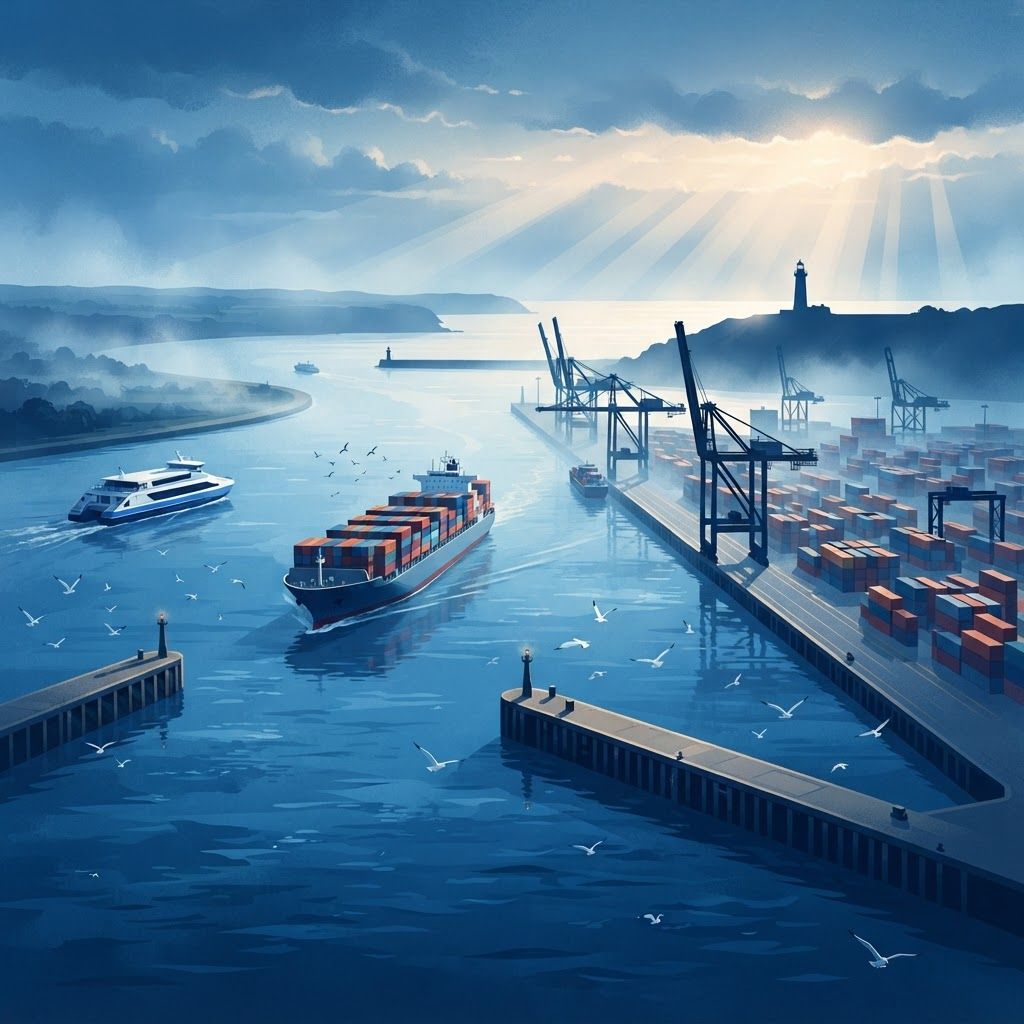
A Maritime Borough
Few places in England have a closer relationship with shipping than South Tyneside. The borough sits on the south bank at the mouth of the Tyne, a river whose identity was built on coal export, shipbuilding and marine engineering. That industrial legacy remains visible in the piers, the quaysides, the dry docks and the skills base, and it continues commercially through the Port of Tyne, ferry operations, offshore support and a substantial marine services sector.
Modern shipping activity here spans several distinct areas. There is short-sea container and bulk traffic, roll-on roll-off ferry services to Northern Europe, offshore wind and subsea project work, vehicle handling, cruise calls bringing visitors to the region, and the supporting network of agents, surveyors, chandlers and repair yards that any working port requires.
Ten Shipping Companies and Maritime Service Providers
1. Port of Tyne. The port authority itself is the central actor, providing berths, cargo handling, bulk and container terminals, warehousing and cruise facilities. Its investment in offshore energy handling and digital port operations has been significant in maintaining the river's commercial relevance.
2. DFDS Seaways. Operator of the North Sea ferry link from the Tyne to Northern Europe, carrying passengers, freight vehicles and unaccompanied trailers. The service matters commercially for exporters and culturally as the borough's direct sea link to the continent.
3. Shields Ferry. The passenger crossing between North and South Shields, part of the integrated regional transport network. Short, frequent and historically continuous, it remains the most direct link across the river mouth.
4. Short-Sea Container Line Operators serving the Tyne. Feeder and short-sea carriers connecting the port with European hub ports, giving North East exporters and importers routing options that avoid long inland hauls to southern ports.
5. Bulk and Dry Cargo Shipping Operators. Carriers handling aggregates, grain, biomass, scrap metal and project cargo through the river's bulk terminals, serving regional industry and energy generation.
6. Offshore Support and Subsea Vessel Operators on the Tyne. Companies providing construction support, cable-lay, survey and maintenance vessels for offshore wind and subsea infrastructure, using the river as a mobilisation base.
7. Ship Agency and Chartering Firms in Tyne and Wear. Agents managing port calls, pilotage arrangements, customs formalities, crew logistics and supplies. Their efficiency directly determines vessel turnaround time and therefore cost.
8. Marine Engineering and Ship Repair Yards. Businesses continuing the borough's engineering tradition through dry docking, hull and machinery repair, fabrication and conversion work for commercial and offshore vessels.
9. Marine Surveying and Classification Consultancies. Independent surveyors and inspection specialists conducting condition surveys, cargo inspections, damage assessment and compliance verification on behalf of owners, charterers and insurers.
10. Cruise Handling and Marine Tourism Operators. Providers managing cruise calls at the Tyne, including passenger handling, shore excursion coordination and onward transport, bringing international visitors into South Tyneside and the wider North East.
What Shippers Should Consider
For businesses moving cargo, routing decisions should compare total landed cost rather than freight rate alone. Using a northern port frequently reduces inland haulage significantly compared with routing through the south, and that saving often outweighs a slightly higher sea freight rate while also cutting emissions and transit risk.
Documentation accuracy is critical. Bills of lading, commodity classification, origin declarations and customs entries must be correct, since errors cause detention, storage charges and penalties that dwarf any saving made on rate negotiation. Working with an experienced agent or forwarder is usually cheaper than learning through mistakes.
Understand liability limits. Carrier liability under standard sea freight conventions is limited and rarely reflects cargo value, so appropriate marine cargo insurance should be arranged separately for anything of significance. Equally, clarify Incoterms precisely, since responsibility for cost, risk and insurance transfers at different points depending on the term used.
Trends in Maritime Operations
Decarbonisation is the dominant force in shipping. Alternative fuels, shore power connection in port, hull efficiency measures and slow steaming are all being deployed, and ports including the Tyne are investing in the infrastructure required to support cleaner vessel operation. This will progressively change both cost structures and berth requirements.
Offshore renewables continue to reshape activity on the river. The North Sea wind sector requires quayside space, heavy lift capability, storage and vessel support, and the Tyne has positioned itself deliberately in this market. This has sustained marine engineering employment in the borough in a way that pure cargo handling alone would not.
Digitalisation is the third theme, with electronic documentation, port community systems, vessel tracking and predictive berth scheduling reducing delay and paperwork. Fourth, supply chain resilience thinking has increased interest in regional ports as alternatives to congested southern gateways.
The Borough's Continuing Maritime Identity
For visitors, the shipping story is genuinely accessible. The piers at the river mouth, the ferry crossing, the views of vessels entering the Tyne and the maritime heritage collections in the borough all connect directly to a working port rather than a museum piece. For businesses, the practical point is that South Tyneside offers immediate access to a modern port with real short-sea, bulk and offshore capability, supported by a marine services cluster with centuries of accumulated expertise.
Want your brand featured in front of decision-makers? Publish a guest post or get a link insertion in our guides through AAMAX's guest post and link insertion service.
Helpful Links
 SponsoredAAMAX — Full-Service Digital Agency
Write for Us
Share your expertise with our readers. We welcome guest contributions from industry specialists.
Pitch your idea