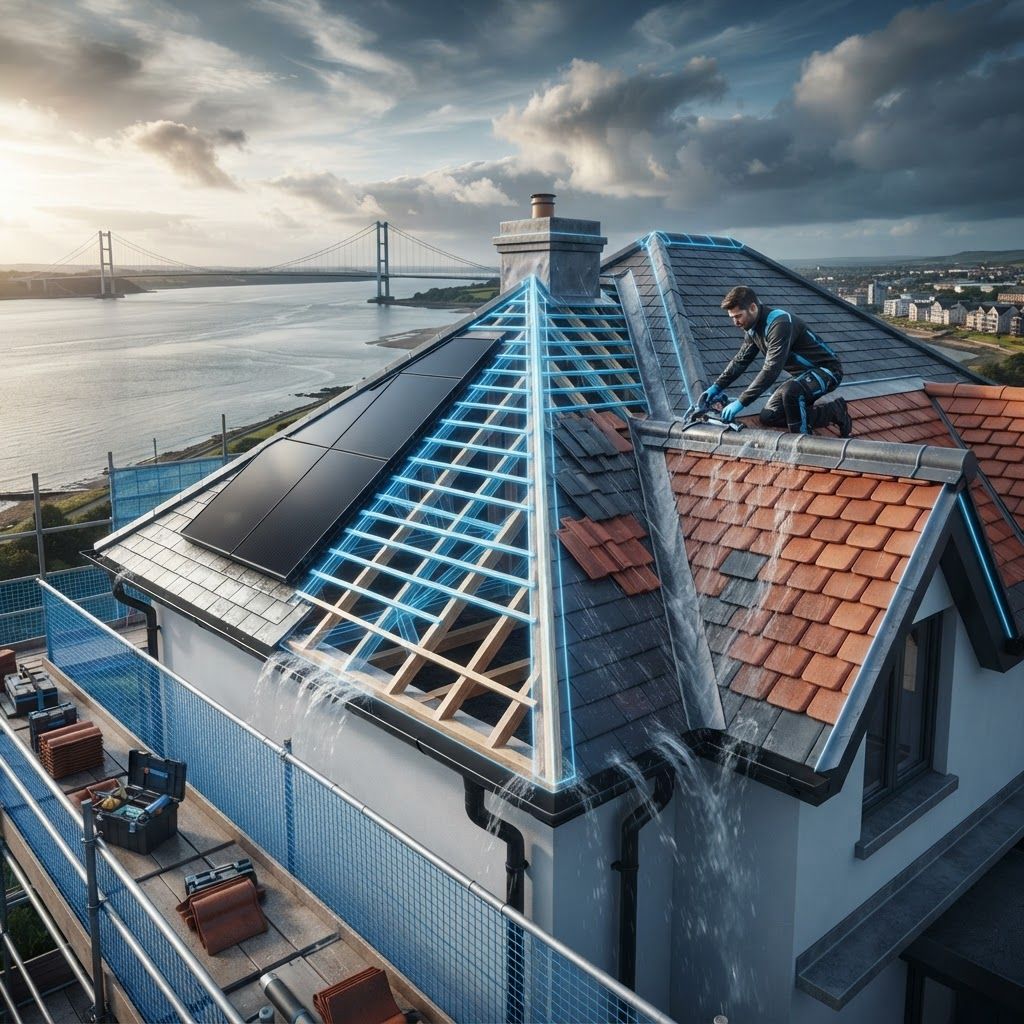
Roofing in an Exposed Climate
North Lincolnshire's roofs work hard. The Humber estuary funnels wind inland, open farmland offers little shelter, and driving rain from the east tests every ridge, verge and flashing. Coastal air carries salt that attacks fixings and metalwork, and winter freeze-thaw cycles exploit any moisture that penetrates tiles or mortar.
The consequence is that roofing standards here matter more than in sheltered inland areas. A roof detail that survives comfortably in a protected valley may fail within a few winters on an exposed ridge near Barton-upon-Humber or across the open Isle of Axholme.
Roof Types Across the Region
Pitched roofs with concrete or clay tiles dominate twentieth-century housing around Scunthorpe. Older properties in the market towns feature natural slate and traditional clay pantiles, the latter being characteristic of the wider Lincolnshire and Humber vernacular. Flat roofs appear on extensions, garages and commercial buildings, increasingly finished in single-ply membrane, ethylene propylene diene monomer rubber or liquid-applied systems rather than traditional felt.
Industrial and agricultural buildings use profiled metal sheeting and composite panels, which bring their own considerations around thermal performance, condensation control and fixing corrosion in coastal conditions.
The Top 10 Roofing Contractors in North Lincolnshire
1. Humber Roofing Contractors
A large, well-equipped roofing firm covering domestic and commercial work. Its scaffolding, safety procedures and workmanship standards are consistently strong, and it provides substantial written guarantees on full re-roofs.
2. Barton Slate and Pantile Specialists
Focused on traditional roofing materials, including natural slate and reclaimed clay pantiles. Essential for conservation area and listed building work where material authenticity is required.
3. Ironstone Flat Roofing
Specialists in single-ply membrane, rubber and liquid-applied flat roof systems, with proper attention to falls, upstands and outlet detailing, which is where most flat roofs actually fail.
4. Brigg Roof Repairs
Concentrates on repair rather than replacement, addressing slipped tiles, failed flashings, leaking valleys and chimney weathering. Honest advice about whether a roof needs repair or renewal is a hallmark.
5. Axholme Agricultural Roofing
Handles large-span metal sheet and composite panel roofing on farm buildings, grain stores and industrial units, including sheet replacement and rooflight installation.
6. Northgate Commercial Roofing
Serves warehouses, factories and retail premises with recladding, insulation upgrades, gutter lining and planned maintenance contracts that prevent reactive emergency work.
7. Riverside Leadwork and Heritage Roofing
A specialist in lead flashing, valleys, chimney weatherings and heritage detailing, using traditional techniques and correct lead codes for long service life.
8. Wolds Solar Roofing
Combines roofing with solar photovoltaic installation, including in-roof integrated systems that sit flush with tiles, addressing both weathertightness and electrical performance.
9. Steelworks Guttering and Rainwater
Focuses on rainwater goods, including gutter replacement, fascia and soffit renewal and drainage connections, an area frequently neglected until damage appears.
10. Ancholme Emergency Roof Response
Provides rapid temporary weatherproofing after storm damage, with tarpaulin covering and follow-up permanent repair, working with insurers on claims documentation.
Trends in Roofing
Insulation upgrades increasingly accompany re-roofing. Replacing a roof provides the natural opportunity to improve thermal performance, either at rafter level for warm roof construction or at ceiling level. Building regulations may require upgrade when a substantial proportion of the roof is renewed.
Integrated solar has matured considerably. In-roof systems now offer better aesthetics and comparable weathertightness to conventional tiling, and combining installation with re-roofing avoids paying for scaffolding twice.
Ventilation has become better understood. Modern roofs need controlled airflow to prevent condensation, particularly where insulation levels have increased. Ridge vents, eaves ventilation and breathable membranes are now standard specification rather than optional extras.
Membrane technology has also improved dramatically for flat roofs. Modern single-ply and rubber systems routinely offer service lives measured in decades rather than the short lifespan associated with older felt roofs.
Recognising Roof Problems Early
Watch for slipped or missing tiles, sagging ridge lines, damaged flashings around chimneys and abutments, blocked or overflowing gutters, and staining on internal ceilings. In lofts, look for daylight through the roof covering, damp timbers, mould on rafters and wet insulation.
Address problems promptly. Water penetration damages timber, insulation and plaster far more expensively than the original roof defect would have cost to repair.
Choosing a Roofer
Verify insurance and ask for written guarantees that specify what is covered and for how long. Ensure scaffolding is used for anything beyond minor work; ladder-only roofing is both unsafe and a sign of a contractor cutting corners. Obtain detailed quotations specifying materials, underlay type, fixing methods and whether battens are being replaced.
Be particularly cautious of unsolicited callers offering roof work, a persistent problem in rural areas. Reputable local roofers rarely need to cold call.
Conclusion
Roofing in North Lincolnshire demands genuine competence given the region's exposure to estuary wind, driving rain and salt air. From traditional pantile and slate work in the market towns to large-span industrial sheeting and integrated solar, the ten contractors profiled here reflect the breadth of expertise available and the standards that local conditions require.
Want your brand featured in front of decision-makers? Publish a guest post or get a link insertion in our guides through AAMAX's guest post and link insertion service.
Helpful Links
 SponsoredAAMAX — Full-Service Digital Agency
Write for Us
Share your expertise with our readers. We welcome guest contributions from industry specialists.
Pitch your idea