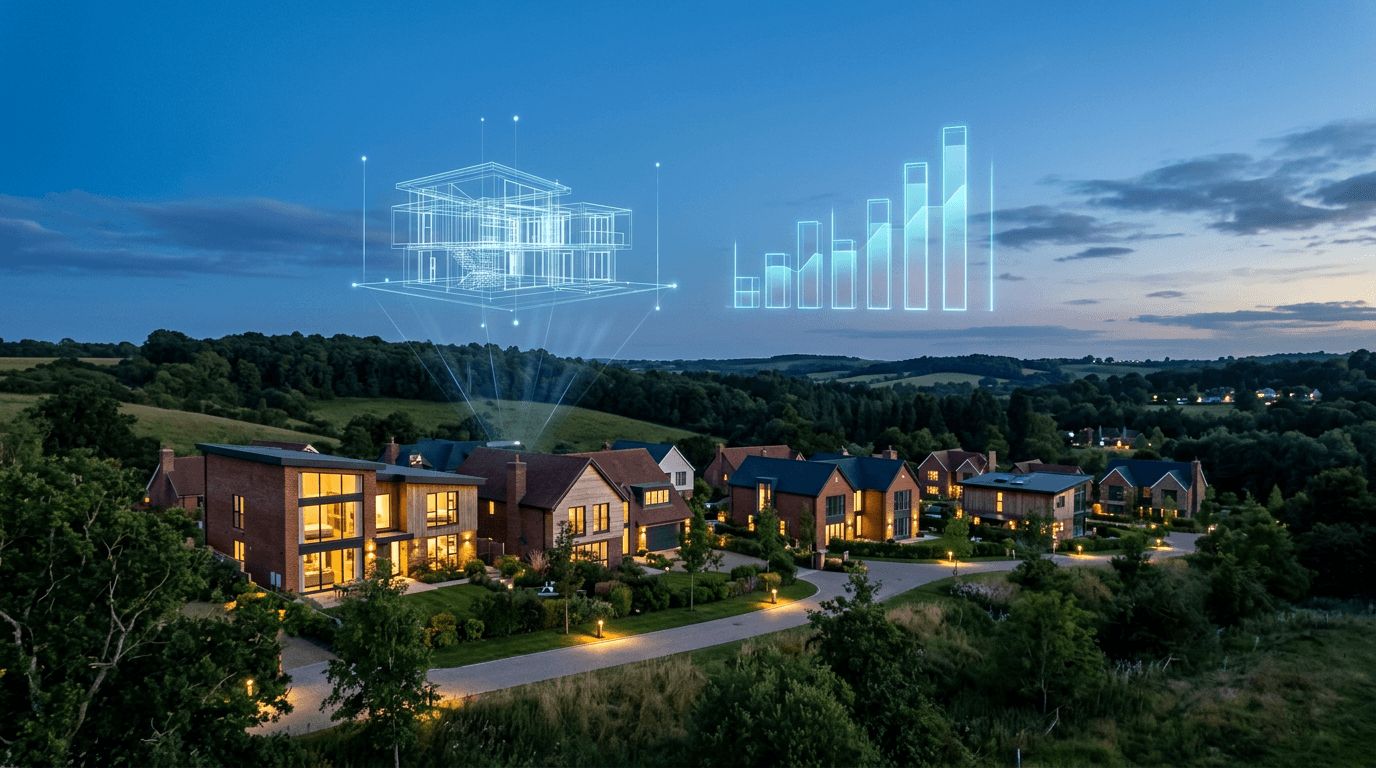
Residential Construction in a High-Value District
Residential construction in East Hertfordshire operates at the demanding end of the market. Property values across the district support substantial investment, meaning clients expect high specification and finish quality. At the same time, the planning environment is restrictive, with extensive Green Belt designation, numerous conservation areas across Hertford, Ware, Bishop's Stortford, Buntingford and the villages, and a significant stock of listed buildings.
The housing stock itself is varied and challenging. Timber-framed cottages, Georgian townhouses, Victorian terraces, interwar semi-detached homes and modern estate housing all coexist within a few miles. Each demands different construction knowledge, and builders who apply modern cavity-wall thinking to a solid-wall period property cause damp and decay problems that emerge years later.
The Ten Best Residential Construction Options
NHBC registered builders operating in the district are essential for any new dwelling. The structural warranty they provide is a lender requirement, and registration involves technical standards inspection throughout construction, which gives clients meaningful independent oversight.
Federation of Master Builders members across Hertfordshire remain the strongest general starting point for extensions and refurbishment. Vetting, financial assessment and inspection of completed work, combined with the availability of insurance-backed warranties, substantially reduces client risk.
Premier Guarantee and LABC Warranty registered developers provide alternative structural warranty provision for new residential construction, accepted by mainstream lenders and covering defects for extended periods after completion.
Self Build and Custom Housebuilding specialist contractors serving Hertfordshire address a growing segment. The district attracts self-builders seeking plots in village locations, and contractors experienced in staged self-build finance, warranty requirements and client-managed procurement are genuinely valuable.
Timber frame specialist builders operating in the region deliver compressed construction programmes and excellent thermal performance. Factory-manufactured panels erected on site reduce weather exposure and labour requirements, which appeals strongly to clients with fixed timescales.
Heritage and listed building contractors in the county are indispensable given the district's protected stock. Competence in lime plaster and mortar, traditional joinery, historic brickwork repair, oak framing and breathable insulation strategies is a specialism that cannot be substituted with general building skill.
Established Hertford and Ware residential builders collectively form the backbone of local delivery. Family firms operating across generations in these towns bring reliable subcontractor networks, familiarity with local authority officers and reputations sustained entirely through referral within tight community networks.
Bishop's Stortford and Sawbridgeworth residential contractors serve the eastern side of the district, frequently handling the large rear and side extension projects characteristic of the area's substantial family housing, along with garage conversions and loft schemes.
Design and build residential specialists covering Hertfordshire offer integrated architectural design, planning management, structural engineering and construction under one contract. For clients without time to coordinate multiple consultants, this reduces both risk and management effort considerably.
Passivhaus and low-energy certified builders complete the list. As energy costs and environmental awareness rise, demand for genuinely high-performance homes with exceptional airtightness, mechanical ventilation with heat recovery and minimal heating demand has grown, and certified practitioners deliver measurably better outcomes than builders simply meeting minimum standards.
Extensions, Loft Conversions and Whole-House Projects
Extension work dominates residential construction volumes in the district. Single-storey rear extensions, side returns, two-storey additions and garage conversions all follow reasonably predictable patterns, but the interfaces are where quality is determined: structural openings, thermal bridging at junctions, drainage connections and weathering details at roof abutments.
Loft conversions are particularly common in the district's Victorian and Edwardian stock. Structural feasibility, head height, staircase compliance, fire escape provision and thermal performance all require careful design, and permitted development limits interact with conservation area status in ways that catch clients unaware.
Whole-house refurbishment is increasingly popular as buyers acquire dated properties in desirable locations. These projects combine structural work, complete services renewal, insulation upgrade and full internal fit-out, and they demand contractors with genuine programme management capability rather than trade coordination alone.
Planning and Regulatory Reality
Clients should approach the planning process with realistic expectations. Green Belt policy substantially limits extension volume and new dwellings. Conservation area designation controls external appearance, materials and window details. Listed building consent involves a separate application, with unauthorised work carrying serious legal consequences.
Building regulations have tightened considerably on energy performance, ventilation and overheating. Contemporary extensions require higher insulation levels, controlled ventilation strategies and attention to solar gain that older approaches ignored. Contractors unfamiliar with current requirements create completion problems that are expensive to remedy retrospectively.
Party wall procedures, structural engineer involvement and drainage authority approvals all add process steps that should be programmed rather than discovered mid-build.
Budgeting and Contract Discipline
Realistic budgeting separates successful projects from difficult ones. Costs should account for design fees, planning and building regulations charges, structural engineering, party wall surveyors, utility diversions, temporary accommodation where relevant, and a genuine contingency of meaningful proportion rather than a token figure.
Fixed-price contracts based on complete drawings and specifications provide the most cost certainty. Where design remains incomplete, clients should expect variation costs and manage them through a formal written change process rather than verbal agreement on site.
Final Thoughts
Residential construction in East Hertfordshire rewards clients who respect the complexity of the local stock and planning environment. Appointing warranty-registered or accredited contractors, engaging genuine heritage specialists for period property, insisting on complete design before tender and maintaining strict contract discipline produces homes that perform well and hold value. The district has the specialist capability available; the discipline lies with the client.
Want your brand featured in front of decision-makers? Publish a guest post or get a link insertion in our guides through AAMAX's guest post and link insertion service.
Helpful Links
 SponsoredAAMAX — Full-Service Digital Agency
Write for Us
Share your expertise with our readers. We welcome guest contributions from industry specialists.
Pitch your idea