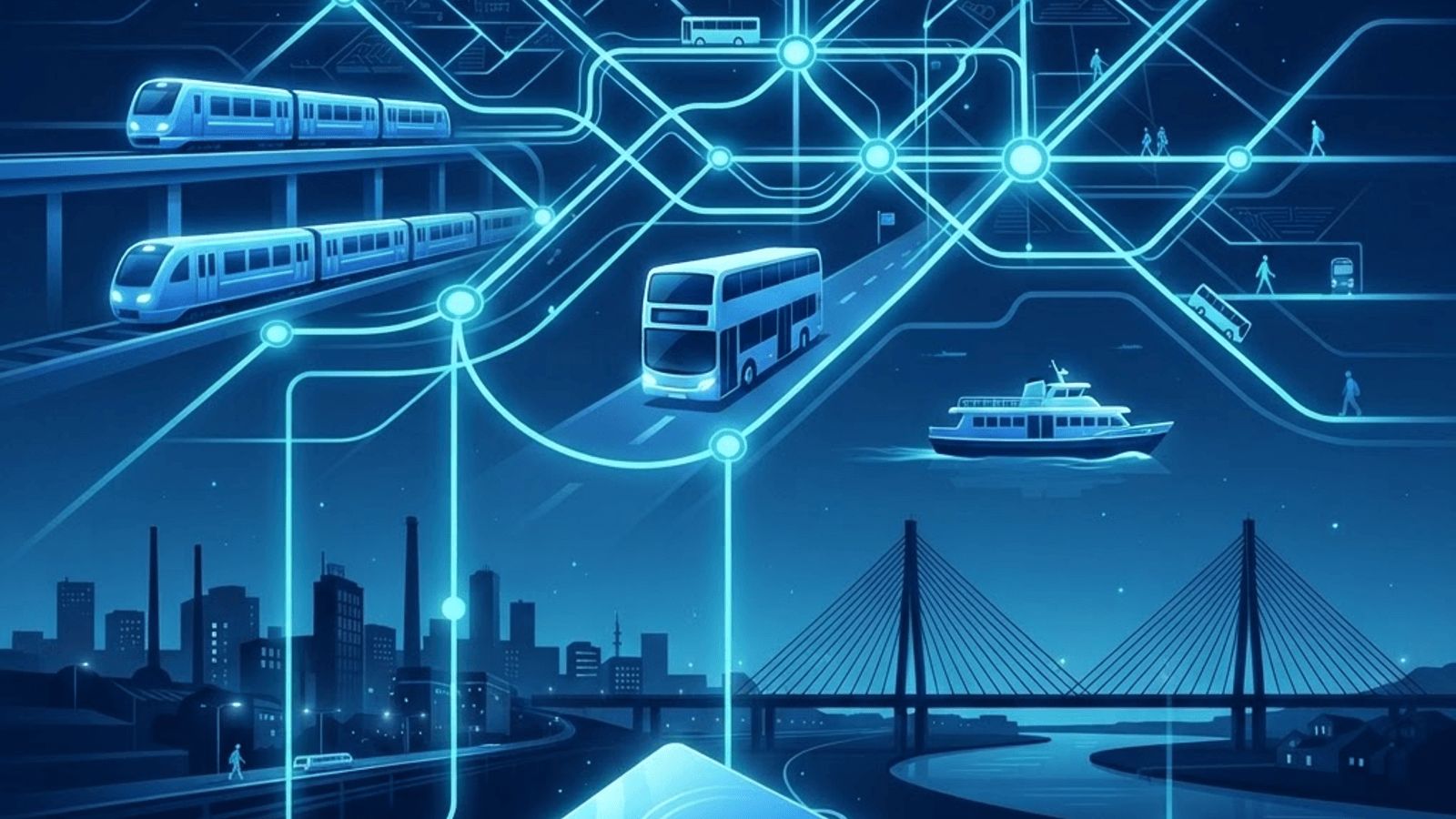
Understanding Public Transport in Middlesbrough
Middlesbrough's public transport system is more layered than its size suggests. The town sits within a polycentric conurbation alongside Stockton, Thornaby, Billingham, Redcar and Hartlepool, meaning many daily journeys cross local authority boundaries. As a result, a genuinely useful transit network has to work across the whole Tees Valley rather than within a single town, and the services that succeed are those offering coherent connections between modes.
The system rests on several pillars. High-frequency bus corridors link the town centre with major residential areas and the hospital. Local rail provides fast connections along the Tees Valley and to the coast. Long-distance rail and coach services connect Teesside to the rest of the country. Community and accessible transport fills gaps for passengers with specific needs. Cycling and walking infrastructure increasingly forms part of the same journey chain, particularly for shorter trips.
Ten Key Public Transit Services
Arriva North East bus network forms the core of local public transport, operating frequent services across Middlesbrough and interurban routes to neighbouring towns. Its route density means most residential areas are within a reasonable walk of a service, and its ticketing products cover a wide geographic area.
Stagecoach North East bus services provide the other major bus network, competing on key corridors and extending coverage towards Hartlepool and Stockton. Its investment in app-based ticketing, contactless capping and live tracking has notably improved the passenger experience.
Northern rail services deliver the local and regional rail offer, connecting Middlesbrough with Darlington, Newcastle, Redcar, Saltburn, Whitby via the Esk Valley line, and across the Pennines. For many commuters, rail is significantly faster than road at peak times.
Middlesbrough Bus Station functions as the central interchange, concentrating services in one place and enabling transfers between operators and towards rail connections. Interchange quality, including shelter, information and step-free access, has a substantial influence on whether people are willing to make multi-leg journeys.
Middlesbrough railway station serves as the town's principal rail gateway following major redevelopment that lengthened platforms and improved facilities, enabling direct intercity services alongside regional trains.
James Cook station is a purpose-built halt serving James Cook University Hospital, one of the largest employers and trip generators in the region. Rail access directly to a major hospital site is a genuinely valuable piece of transport planning, benefiting staff, patients and visitors alike.
TransPennine Express supplies longer-distance regional services including links to Manchester Airport, York and Leeds, offering higher-specification trains with reservable seating for journeys where comfort matters.
Middlesbrough Community Transport and similar community operators provide accessible minibus services, group transport and demand-responsive journeys for passengers who cannot readily use conventional services. This tier is essential for social inclusion and for reducing isolation among older residents.
Tees Valley Combined Authority transport initiatives shape the strategic picture, funding station improvements, bus priority measures, cycling infrastructure and integrated ticketing work. Devolved transport funding has become a major determinant of local service quality.
Concessionary travel and network ticketing schemes, including the English National Concessionary Travel Scheme and multi-operator products covering the Tees Valley, are arguably as important as any single operator. They determine whether the network feels like one system or a collection of competing services.
Trends in Local Public Transport
Fleet decarbonisation is the most visible improvement, with electric and low-emission buses entering service across the North East and delivering quieter, cleaner journeys along busy urban corridors. Depot charging capacity is currently the main limiting factor on the pace of change.
Integration is the second major theme. Multi-operator ticketing, coordinated timetables and better interchange facilities are steadily reducing the penalties historically associated with transferring between services. Real-time information, both at stops and through apps, has removed much of the uncertainty that deterred occasional users.
Active travel has become part of mainstream transport policy, with segregated cycle routes, improved crossings and cycle parking at stations creating practical first and last mile options. Combining a short cycle with a train journey is now realistic for many Tees Valley commuters.
Demand-responsive transport has also been trialled in various forms nationally, using app-booked minibuses in areas where fixed routes are uneconomic. The model shows promise for low-density estates and evening travel, though sustainable economics remain a challenge.
Practical Guidance for Passengers
Choose ticketing deliberately. Weekly and monthly passes typically deliver substantial savings for regular commuters, and contactless daily capping protects occasional users from overpaying. Where a journey involves two operators, verify that a multi-operator product covers it, since single-operator tickets will not.
Plan around frequency rather than timetable for high-frequency corridors, but check specific departures for evening, Sunday and rural services, where gaps are considerably longer. Live tracking apps are more reliable than printed timetables for real-world planning.
Accessibility provision has improved markedly, with low-floor buses, audio-visual announcements and step-free access at key stations, but coverage is not universal. Passengers requiring assistance on rail should book it in advance to guarantee staff availability.
For airport travel, allow generous connection time and confirm the last available return service, since late-evening options are limited across the region.
A Network Moving in the Right Direction
Middlesbrough's public transport is not without gaps, particularly in evening frequency and cross-town connectivity, but the combination of two substantial bus operators, improved rail services, better interchanges, growing active travel infrastructure and increasingly integrated ticketing represents genuine progress. For a large share of local journeys, public transport is already the cheapest and often the most convenient way to travel.
Want your brand featured in front of decision-makers? Publish a guest post or get a link insertion in our guides through AAMAX's guest post and link insertion service.
Helpful Links
 SponsoredAAMAX — Full-Service Digital Agency
Write for Us
Share your expertise with our readers. We welcome guest contributions from industry specialists.
Pitch your idea