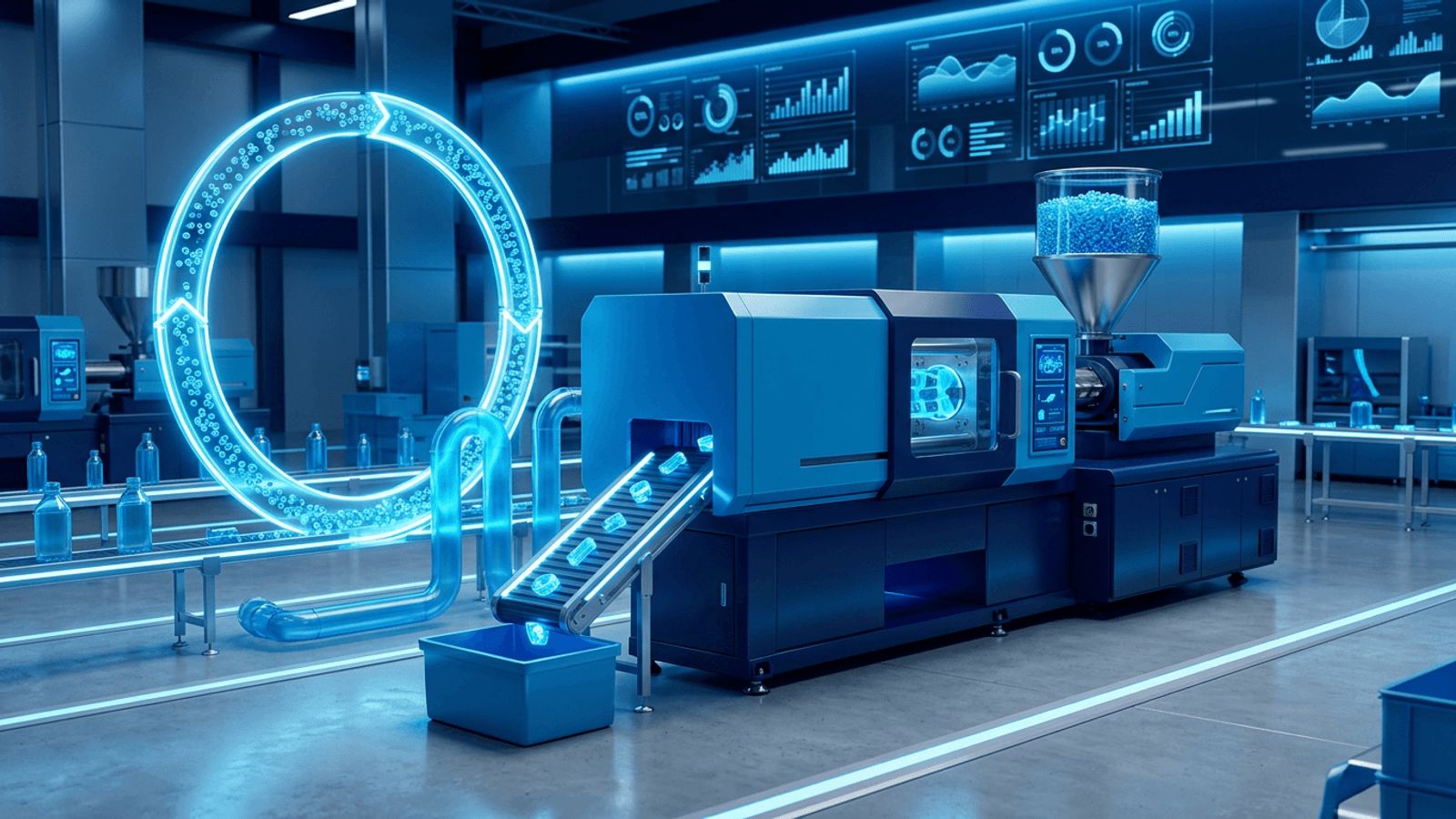
Plastics manufacturing remains one of Slough's more substantial industrial activities, supported by the town's engineering base, its industrial power infrastructure and its position within reach of London's packaging, medical, retail and construction markets. The sector covers a wide range of processes, each suited to different volumes, geometries and materials, and understanding those differences is essential when specifying a component.
The Main Processes Explained
Injection moulding suits high volumes of dimensionally precise parts but requires significant tooling investment. Extrusion produces continuous profiles, pipes, sheets and film. Blow moulding creates hollow containers. Vacuum forming and thermoforming handle larger, shallower parts at lower tooling cost, making them ideal for medium volumes. Rotational moulding produces large hollow items such as tanks. Fabrication and machining serve prototypes, one-offs and very low volumes where tooling cannot be justified.
Choosing the wrong process is the most common and most expensive mistake in plastics procurement. A reputable manufacturer will advise on process selection honestly, even when the answer points to a different supplier.
Top 10 Best Plastic Manufacturers in Slough
1. Thames Valley Plastics
An injection moulding specialist producing technical components for industrial, electrical and consumer applications. Thames Valley Plastics is known for in-house tool maintenance, robust process monitoring and consistent dimensional accuracy across long production runs.
2. Berkshire Moulding Group
Berkshire Moulding Group focuses on medium-volume moulding with insert moulding, overmoulding and assembly capability, supporting customers who need finished subassemblies rather than loose parts.
3. Slough Extrusion Products
This company manufactures profiles, tubing and sheet materials for construction, signage and industrial applications, offering custom die development and co-extrusion for multi-material profiles.
4. Crown Thermoforming
Crown Thermoforming produces vacuum formed and pressure formed components, including machine covers, trays, point-of-sale housings and protective packaging, with relatively low tooling cost and quick development cycles.
5. Bath Road Plastic Fabrication
Bath Road Plastic Fabrication builds bespoke items from sheet materials, covering machine guarding, tanks, display cases and laboratory enclosures, using welding, bending and computer-controlled machining.
6. Langley Medical Plastics
Langley Medical Plastics manufactures components for medical and diagnostic devices in controlled environments, with validated processes, material traceability and documentation suited to regulated supply.
7. Upton Packaging Solutions
Upton produces rigid plastic packaging, including containers, closures and protective inserts, and increasingly develops mono-material designs to improve recyclability.
8. Herschel Rotational Moulding
Herschel Rotational Moulding creates large hollow products such as water tanks, containers and material handling equipment, benefiting from uniform wall thickness and high impact resistance.
9. Windsor Gate Recycled Polymers
Windsor Gate Recycled Polymers processes post-industrial and post-consumer plastic into reusable regrind and compounded material, with testing to verify mechanical properties for onward manufacturing.
10. Trelawney Tooling and Prototyping
Trelawney designs and manufactures moulds and provides rapid prototyping through additive manufacturing and machining, enabling design validation before committing to production tooling.
Trends Reshaping the Plastics Sector
Sustainability is the defining force. Packaging taxes based on recycled content, retailer commitments on recyclability and consumer scrutiny have pushed recycled polymer from a marginal option to a mainstream requirement. That creates technical challenges, since recycled material behaves less predictably than virgin resin, and it has driven demand for compatibilisers, additives and tighter process control.
Design for recycling is changing product architecture. Multi-material laminates and mixed-polymer assemblies are giving way to mono-material designs, reduced pigment use and mechanical fastening rather than adhesives, all of which improve end-of-life recovery. Lightweighting continues in parallel, reducing material use and transport emissions simultaneously.
On the process side, energy efficiency has become a serious commercial factor. All-electric moulding machines, improved thermal insulation and heat recovery reduce energy per part significantly, which matters greatly when electricity is a leading cost input. Automation, robotic part removal and in-line vision inspection are also increasingly standard, improving consistency and reducing scrap.
How to Choose a Plastics Manufacturer
Discuss the process before the price. Provide expected annual volumes, tolerances, environmental exposure, regulatory requirements and target cost, then ask the manufacturer to recommend the process and material. Be wary of any supplier who quotes without asking about end use.
Clarify tooling ownership, storage responsibility and maintenance obligations in writing, as this becomes a significant issue if you later change supplier. Confirm material certification, particularly for food contact, medical or flame-retardant applications. Ask about inspection methods, capability data and how the manufacturer handles material substitution if a grade becomes unavailable. Finally, discuss recycled content options early, since retrofitting them into an approved design is far harder than designing for them from the start.
Material Selection in Practice
Polymer choice determines cost, performance and recyclability simultaneously, and the best decision is rarely the most familiar material. Polypropylene offers excellent chemical resistance and living hinge capability at low cost. Polycarbonate provides impact strength and clarity but scratches easily. Nylon handles wear and elevated temperature well. Engineering grades solve demanding problems but complicate recycling and raise price considerably.
Fillers, glass reinforcement, ultraviolet stabilisers and flame retardants shift these properties further. Slough manufacturers with in-house technical staff can run comparative trials on candidate grades before tooling is cut, testing actual parts rather than relying on datasheet values that were measured on idealised specimens under laboratory conditions.
Final Thoughts
Plastics remain indispensable across almost every industry, and Slough's manufacturers combine established process expertise with growing capability in recycled materials and efficient production. For buyers, engaging a local manufacturer early in the design process usually delivers better parts at lower total cost than treating moulding as a commodity purchase at the end of development.
Want your brand featured in front of decision-makers? Publish a guest post or get a link insertion in our guides through AAMAX's guest post and link insertion service.
Helpful Links
 SponsoredAAMAX — Full-Service Digital Agency
Write for Us
Share your expertise with our readers. We welcome guest contributions from industry specialists.
Pitch your idea