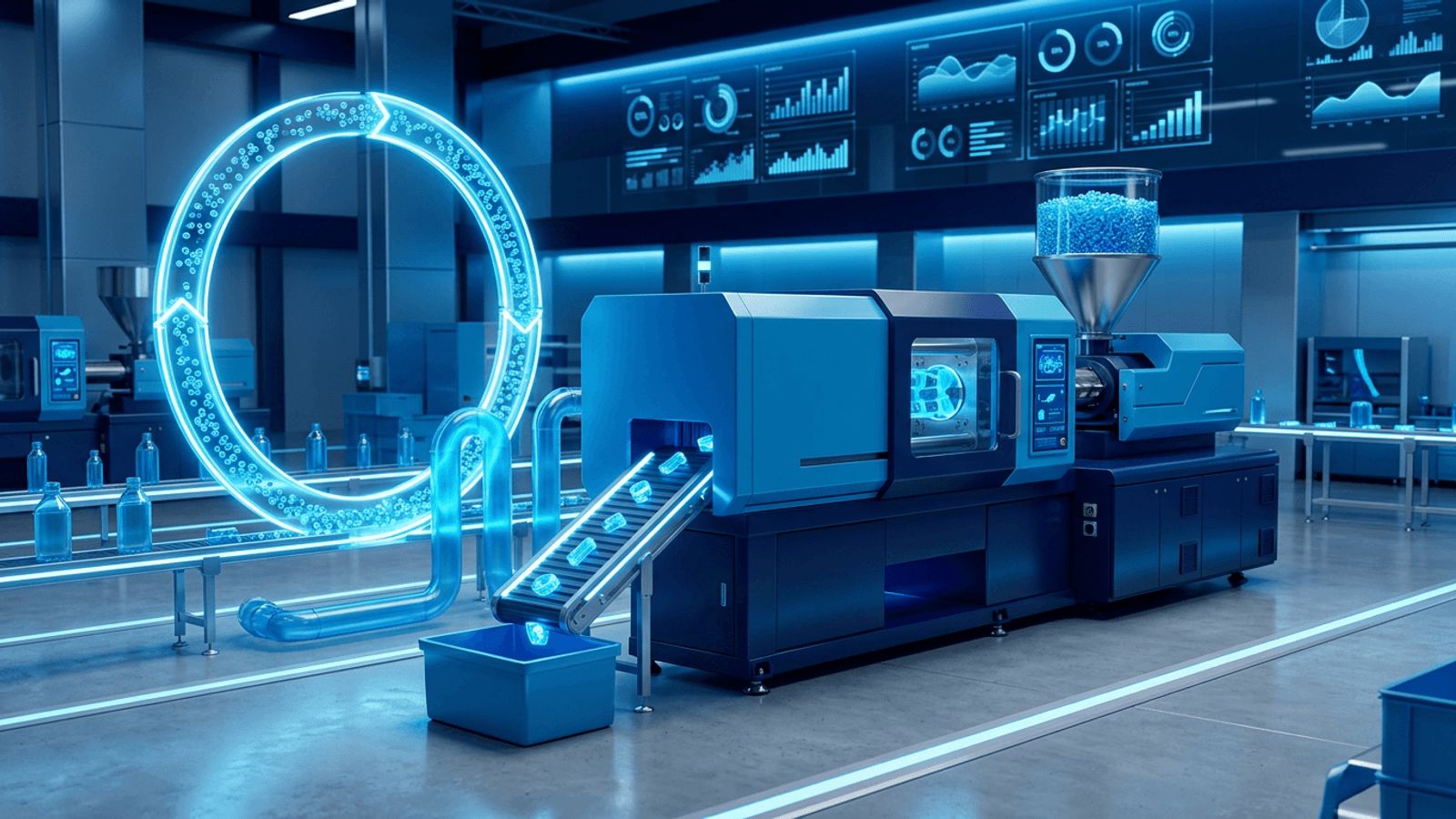
Plastics Manufacturing in North Wales
Plastics remain essential to modern manufacturing, and Conwy hosts a capable group of businesses working across moulding, forming, machining and fabrication. The local sector serves construction, marine, agriculture, food packaging, signage and the medical supply chain, generally at low to medium volume where flexibility and responsiveness matter more than the lowest possible unit cost.
The industry is also changing quickly. Environmental scrutiny, extended producer responsibility, plastic packaging taxation and customer demand for recycled content have all reshaped what manufacturers offer. The most successful Conwy firms have responded by developing recycling capability, working with recycled and bio-based polymers, and helping clients redesign products to use less material.
The Main Processes and What They Suit
Injection moulding produces high volumes of identical parts with excellent repeatability, but requires significant tooling investment, making it suitable once volumes justify the mould cost. Vacuum forming and thermoforming create larger, shallower parts with much cheaper tooling, ideal for trays, covers, housings and signage at lower volumes. Extrusion produces continuous profiles, pipes and sheet. Rotational moulding suits large hollow items such as tanks and containers. Plastic fabrication and welding builds bespoke items from sheet material, offering one-off and small batch capability with no tooling at all. Computer numerical control machining of plastics delivers precision parts and prototypes directly from stock material.
Ten Plastic Manufacturers and Fabricators Serving Conwy
1. Conwy Polymer Products operates injection moulding for low to medium volume runs, offering tooling development alongside production and providing guidance on design for manufacture that frequently reduces part cost significantly.
2. North Wales Thermoforming specialises in vacuum forming for trays, covers, machine guarding and point-of-sale items, a cost-effective route for clients whose volumes cannot justify injection tooling.
3. Bay Plastic Fabrications fabricates and welds acrylic, polycarbonate and polypropylene sheet into tanks, guards, display units and bespoke enclosures, working entirely to order with no tooling requirement.
4. Snowdonia Rotational Moulding produces large hollow components including water tanks, planters, buoys and storage containers suited to agricultural and marine use in exposed conditions.
5. Carneddau Recycled Polymers processes post-industrial and post-consumer plastic waste into regranulated material and finished products, supporting clients who need recycled content in their supply chain.
6. Llandudno Signage and Display manufactures acrylic and composite signage, display stands and protective screens, combining plastic fabrication with printing and finishing.
7. Clwyd Plastic Machining offers precision machining of engineering plastics including nylon, acetal and polyethylene terephthalate, producing bearings, bushes, wear strips and prototype components.
8. Aberconwy Packaging Solutions supplies formed and moulded packaging for food producers and manufacturers, with growing emphasis on recyclable mono-material designs that simplify end-of-life processing.
9. Colwyn Bay Extrusions produces plastic profiles, edging and trim for construction and furniture applications, offering custom die development for specific sections.
10. Conwy Marine Plastics manufactures components for the leisure marine sector, including hatches, fittings, fenders and moulded parts specified for ultraviolet and saltwater resistance.
Choosing the Right Material
Material selection drives performance, cost and recyclability. Polypropylene is tough, chemically resistant and widely recycled. Polyethylene in its various densities suits tanks, containers and outdoor applications. Acrylonitrile butadiene styrene offers rigidity and a good surface finish for consumer housings. Polycarbonate provides exceptional impact resistance and optical clarity. Acrylic gives clarity and weather resistance at lower cost but with more brittleness. Engineering plastics such as nylon and acetal provide low friction and dimensional stability for mechanical parts.
For outdoor and marine applications in Conwy, ultraviolet stabilisation is essential. Untreated plastics degrade noticeably under coastal exposure, becoming brittle and discoloured within a few seasons.
Tooling, Volume and Cost
The single biggest decision in plastics is whether volume justifies tooling. Injection moulds represent a substantial up-front cost that is amortised across production, meaning unit cost falls sharply with quantity. For annual volumes in the hundreds rather than thousands, thermoforming, fabrication or machining will almost always prove more economical overall.
Good manufacturers will advise honestly on this rather than defaulting to their own preferred process. A conversation about realistic annual volumes, expected product lifespan and likely design changes should happen before any tooling is commissioned.
Sustainability and Regulation
Packaging taxation now applies to plastic packaging with insufficient recycled content, which has driven rapid adoption of recycled polymers. Extended producer responsibility places greater obligations on businesses placing packaging on the market. Designers are responding by reducing material use, eliminating mixed-material constructions that cannot be recycled, and designing for disassembly.
Conwy manufacturers working with recycled feedstock and mono-material design are well placed to help clients meet these obligations. Buyers should ask specifically about recycled content options, material identification marking and take-back arrangements for production waste.
Selecting a Manufacturer
Ask which processes the firm operates in house rather than subcontracts. Request samples of comparable parts and ask about tolerance capability, as plastics shrink and move in ways metals do not. Discuss quality inspection procedures and, for food contact or medical applications, confirm the relevant compliance credentials in writing.
Above all, engage a manufacturer early in product development. Design decisions made before a mould is cut determine the majority of eventual cost, and Conwy's plastics firms consistently report that the projects running most smoothly are those where they were consulted during design rather than handed a finished drawing.
Want your brand featured in front of decision-makers? Publish a guest post or get a link insertion in our guides through AAMAX's guest post and link insertion service.
Helpful Links
 SponsoredAAMAX — Full-Service Digital Agency
Write for Us
Share your expertise with our readers. We welcome guest contributions from industry specialists.
Pitch your idea