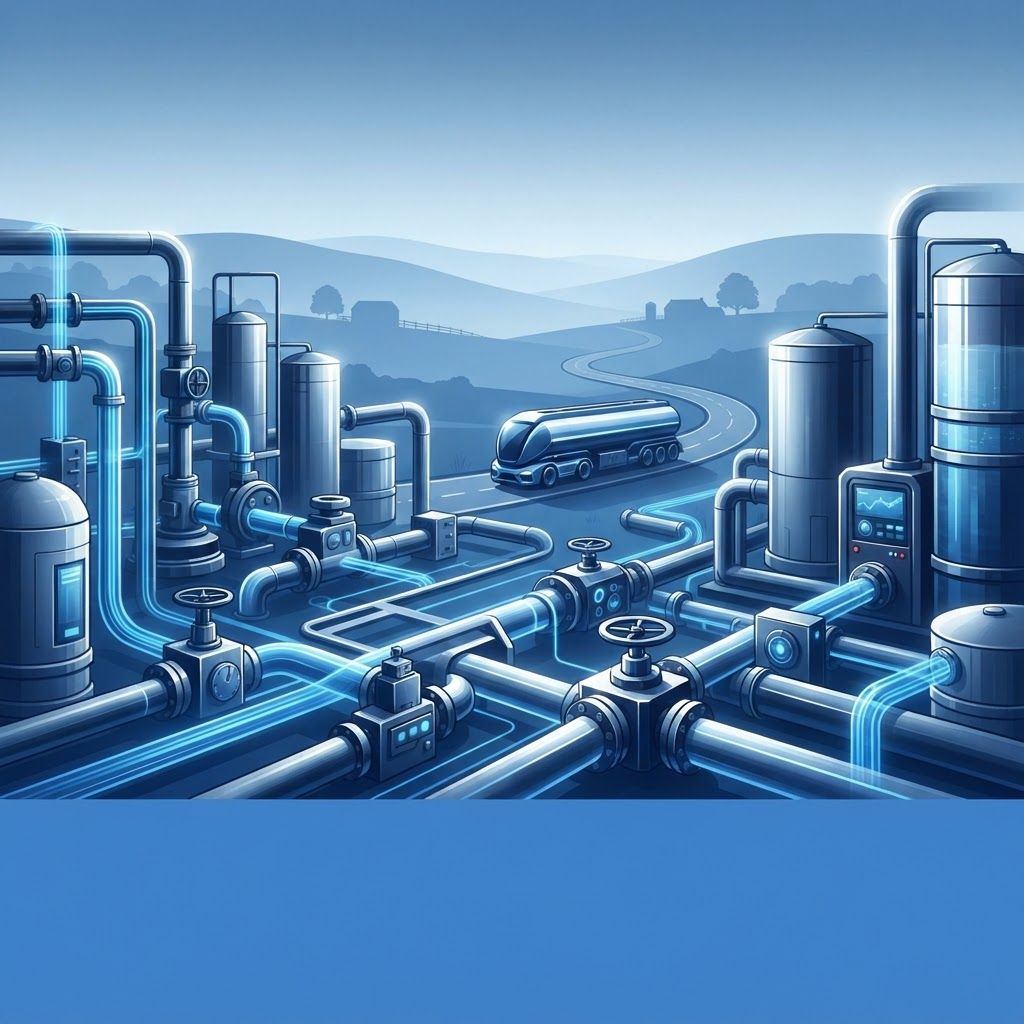
Why Oil and Gas Matter So Much in Herefordshire
Herefordshire has one of the highest proportions of properties off the mains gas grid of any English county. The mains gas network follows population density, and in a county of scattered villages, isolated farmsteads and market towns separated by open countryside, extending pipelines has never been economic. The practical consequence is that a very large share of local homes, farms and businesses depend on delivered fuel, principally heating oil, also known as kerosene, and liquefied petroleum gas.
This creates a distinct commercial sector with its own dynamics. Unlike mains gas, where supply is continuous and billed after use, delivered fuel requires storage on site, planned ordering, and exposure to volatile wholesale price movements. Households and farms effectively become fuel buyers, making decisions about when to fill, how much to store and which supplier to use. Alongside domestic heating, the county's agricultural sector consumes substantial volumes of gas oil for tractors and machinery, and its logistics and haulage operators need bulk diesel supply.
Understanding the Fuel Types
Kerosene, sold as heating oil, is the standard domestic heating fuel for off-grid properties, burned in oil-fired boilers and range cookers. It is stored in above-ground plastic or steel tanks, typically holding between one thousand and two thousand five hundred litres for a household.
Gas oil, historically known as red diesel, is used in agricultural and construction machinery, and static plant such as generators and grain dryers. Its permitted uses have narrowed considerably following changes to rebated fuel entitlement, and businesses need to be clear about which of their operations still qualify. Liquefied petroleum gas, supplied as propane in bulk tanks or cylinders, serves heating, cooking, commercial catering and some agricultural applications such as poultry house heating and crop drying. Road diesel and petrol supply for commercial fleets forms a further category, often supplied through bunkered on-site tanks with fuel management systems.
1. Wye Valley Fuels
A long-established regional distributor, Wye Valley Fuels supplies domestic heating oil, agricultural gas oil and commercial diesel across the county. Its service includes scheduled and emergency deliveries, budget payment plans spreading annual cost across monthly instalments, and top-up monitoring. Rural customers particularly value its willingness to reach properties with difficult access, where narrow lanes and long farm tracks defeat larger tankers.
2. Marches Agricultural Fuel Supply
Focused on the farming sector, this supplier delivers bulk gas oil, agricultural lubricants, AdBlue and tank equipment. Its expertise covers the compliance boundaries of rebated fuel use, bulk storage requirements for agricultural premises, and supply scheduling around the intense demands of harvest and drilling seasons when machinery runs almost continuously. It also advises on fuel security measures, as rural fuel theft is a persistent problem.
3. Herefordshire LPG Solutions
Specialising in liquefied petroleum gas, this company supplies bulk propane and cylinders alongside tank installation and maintenance. Its services extend to boiler and appliance conversion from oil to LPG, commercial catering supply for pubs and restaurants, and agricultural applications including poultry house heating. It handles tank siting to comply with separation distance requirements, an area where mistakes are costly to remedy.
4. Leominster Heating Oil Company
Serving north Herefordshire, this distributor concentrates on domestic heating oil with an emphasis on reliability and transparent pricing. It offers order-by-phone and online ordering, flexible delivery quantities for households on constrained budgets, and group buying schemes where neighbouring properties combine orders to secure better rates. Community buying has become genuinely popular in villages across the county.
5. Cathedral Commercial Fuels
Focused on business customers, Cathedral Commercial Fuels supplies bulk diesel, gas oil and lubricants to haulage operators, plant hire firms, construction sites and food distribution businesses. Its offering includes on-site bunkered tank installation, fuel management systems with driver and vehicle level reporting, and fuel cards for network purchasing. Its consumption analysis helps fleet operators identify inefficiency and theft.
6. Golden Valley Tank Services
Rather than supplying fuel, this company installs, inspects and maintains storage tanks. Services cover replacement of ageing single-skin tanks with compliant bunded units, base construction, siting assessment against building regulations and pollution prevention requirements, integrity testing, decommissioning of redundant tanks and remediation of contaminated ground. With many Herefordshire tanks now decades old, replacement demand is substantial.
7. Ross-on-Wye Oil Boiler Engineers
This company services the appliance rather than the fuel, providing oil boiler installation, annual servicing, breakdown repair and commissioning, together with range cooker maintenance. Its engineers hold the relevant competent person registration for oil-fired appliances. Regular servicing is more consequential for oil systems than mains gas, since fuel quality, tank condition and nozzle wear all affect combustion efficiency directly.
8. Border Counties Fuel Buying Group
Operating as a collective purchasing organisation, this group aggregates demand from households, farms, village halls and community buildings to negotiate improved pricing from distributors. Members benefit from volume rates that individual buyers could not access, along with coordinated delivery scheduling. The model has proved effective in rural areas and provides a practical response to fuel poverty in hard-to-heat off-grid homes.
9. Ledbury Fuel Additives and Testing
This specialist addresses fuel quality, offering tank sampling and laboratory testing, water and sludge removal, microbial contamination treatment and additive supply to improve combustion and storage stability. Diesel bug, a microbial growth thriving at the water interface in storage tanks, causes filter blockage and injector damage, and is a common but frequently misdiagnosed cause of boiler and machinery failure.
10. Herefordshire Energy Transition Advisers
Reflecting the sector's changing future, this consultancy advises off-grid property owners on options for reducing and eventually replacing fossil fuel heating. Its work covers heat loss assessment, comparison of oil, LPG, heat pump and biomass options on realistic running cost assumptions, phased improvement planning, and guidance on renewable liquid fuel alternatives being trialled for the off-grid sector. Its independence from any fuel or technology supplier is central to its proposition.
Tank Compliance and Safety
Oil storage carries real regulatory and environmental obligations. Domestic tanks above a certain capacity, and effectively all commercial tanks, must be bunded, meaning they incorporate a secondary containment shell holding at least one hundred and ten per cent of the primary tank volume. Tanks must be sited at prescribed minimum distances from buildings, boundaries, openings and drains, with fire protection where distances cannot be achieved.
Pollution risk is the principal concern. An oil spill from a failed tank can contaminate soil, groundwater and watercourses, and remediation costs frequently run into tens of thousands of pounds. Many household insurance policies limit cover for pollution, making tank condition a financial as well as environmental issue. Annual inspection for cracking, staining, bulging and corrosion is prudent, and any tank showing distress should be replaced rather than patched.
Buying Fuel Sensibly
Heating oil prices are volatile and seasonal, typically rising through autumn and winter as demand peaks. Buying in late spring and summer usually secures better rates, provided storage capacity allows. Monitoring tank levels and ordering before reaching a critical level avoids emergency delivery premiums and the risk of running dry, which can draw sludge into the fuel line.
Compare suppliers on delivered price rather than headline rate, checking minimum order quantities and any delivery surcharges for difficult access. Consider joining a buying group. For businesses, ensure clarity on rebated fuel entitlement, since incorrect use of gas oil carries significant penalties. Keep delivery records, which matter both for fuel duty compliance and for insurance purposes.
Final Thoughts
Herefordshire's oil and gas sector performs an essential function in a county where most properties will never receive mains gas. The suppliers, tank specialists, boiler engineers and buying groups profiled here keep homes heated, farms operating and fleets running. The sector faces genuine long-term change as heating decarbonisation progresses, and the most forward-looking operators are already positioning themselves as broader energy service providers. For customers, the practical priorities remain the same, namely maintaining compliant and sound storage, servicing appliances properly, and buying fuel strategically rather than reactively.
Want your brand featured in front of decision-makers? Publish a guest post or get a link insertion in our guides through AAMAX's guest post and link insertion service.
Helpful Links
 SponsoredAAMAX — Full-Service Digital Agency
Write for Us
Share your expertise with our readers. We welcome guest contributions from industry specialists.
Pitch your idea