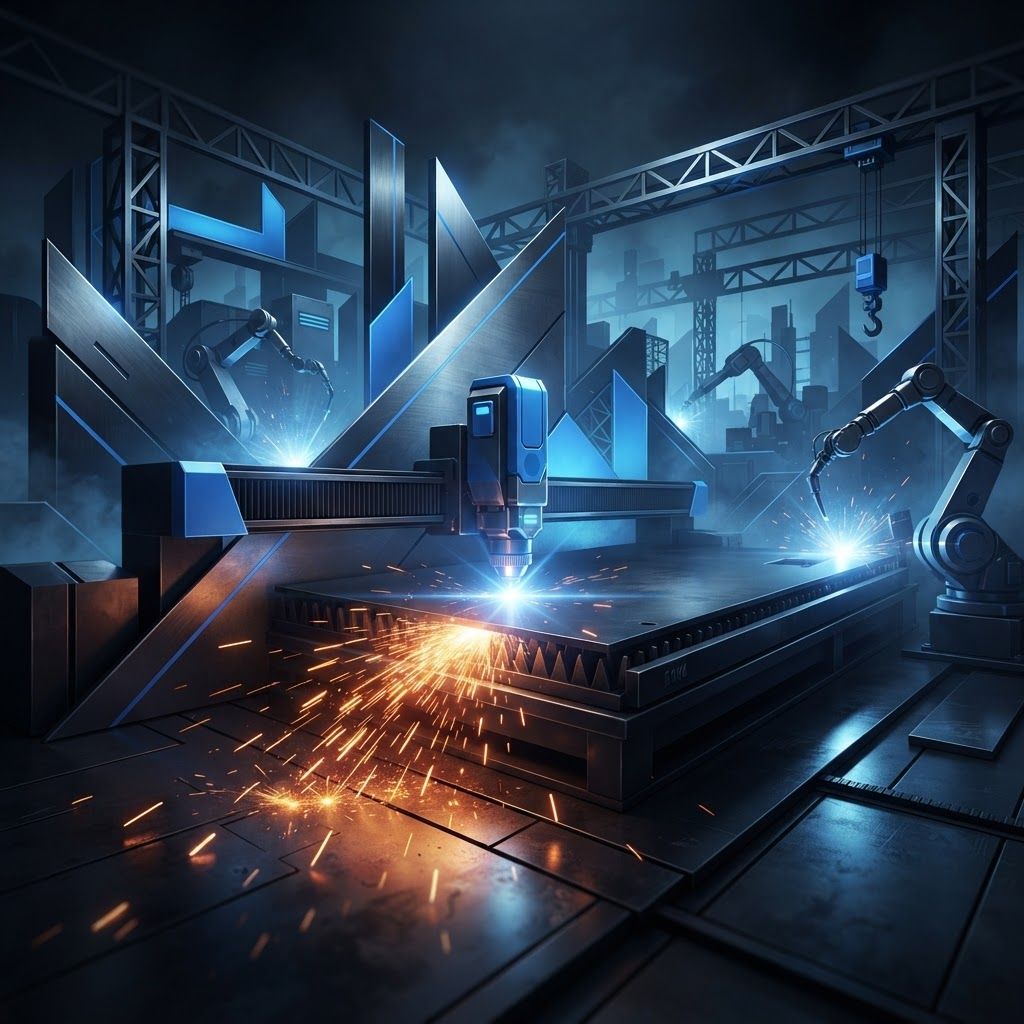
Metal in the Valleys
Wherever there were mills, there were forges and foundries. Stroud's textile industry required ironwork for machinery, waterwheels, shafting and buildings, and the metalworking trades that grew alongside the cloth trade outlasted it. Today the district supports a broad metalworks sector: structural steel fabricators serving construction, precision machinists supplying engineering customers, sheet metal specialists, welders, architectural metalworkers and traditional blacksmiths.
This range is one of Stroud's practical strengths. A homeowner needing a hand-forged gate, a builder needing steel beams for a barn conversion and a manufacturer needing machined components can all find capable suppliers within a short drive.
Companies and Capabilities Locally
Structural steel fabricators around Stonehouse, Gloucester and the M5 corridor supply and erect beams, columns, portal frames and staircases. They work closely with structural engineers and typically handle design detailing, fabrication, protective treatment and site installation. In a district full of barn conversions and mill redevelopments, steel that opens up historic structures is in constant demand.
Precision machining firms offer CNC turning and milling to tight tolerances for engineering customers. The regional presence of Renishaw at Wotton-under-Edge has raised standards considerably, and many local shops supply into aerospace, instrumentation and medical supply chains where documentation and traceability are as important as the parts themselves.
Sheet metal fabricators provide laser and plasma cutting, punching, folding, rolling and welding in steel, stainless and aluminium. Products range from machine guarding and enclosures to ductwork, balustrades and kitchen equipment. Stainless fabrication is particularly relevant to Gloucestershire's food and drink producers, where hygienic design standards apply.
Architectural metalwork is a visible local strength. Blacksmiths and metal artists across the Five Valleys produce gates, railings, balustrades, fire surrounds, signage and sculpture. The district's craft culture supports genuine forge work rather than purely welded imitation, and pieces by local smiths appear throughout Stroud, Nailsworth and Painswick.
Supporting services include galvanizing and powder coating, shot blasting, heat treatment, laser cutting bureaux, metal stockholders such as Righton Blackburns and ASD Metal Services, and scrap metal recyclers who close the material loop.
Services in Detail
Fabrication begins with drawings. The best firms work from three-dimensional models, producing accurate cut lists and minimising site adjustment. Welding to coded standards, with qualified welders and documented procedures, is essential for structural and pressure applications, and buyers should confirm this rather than assume it.
Machining covers everything from single prototype parts to production batches. Modern multi-axis machines produce complex geometries in one setup, improving accuracy and reducing cost. Many shops also offer inspection using coordinate measuring machines, providing dimensional reports with delivered parts.
Surface treatment matters enormously for longevity, particularly on external work in a damp valley climate. Hot dip galvanizing provides the most durable protection for structural steel, often followed by powder coating for appearance. Stainless grades must be selected appropriately; the wrong grade will stain in a marine or chemically aggressive environment.
Repair and restoration form a steady workload. Historic ironwork on Stroud's buildings, canal infrastructure and railings requires sympathetic repair using traditional techniques, and several local smiths specialise in exactly this.
Standards and Compliance
Structural steelwork for construction must comply with the relevant execution standards, and fabricators require factory production control certification to CE or UKCA mark their products. Buyers should ask for evidence of this and for the execution class applicable to their project, as requirements differ between a domestic extension and a public building.
Welding qualifications, material certificates confirming grade and origin, and non-destructive testing where specified all form part of a proper quality package. Reputable fabricators supply this documentation without being chased.
For machined components, ISO 9001 is the baseline, with AS9100 for aerospace and ISO 13485 for medical. Understanding which standard your application demands prevents expensive requalification later.
Trends in the Sector
Automation is spreading. Fibre laser cutters, automated press brakes and robotic welding cells have improved speed, consistency and safety while allowing smaller batches to be produced economically. This benefits customers who need short runs without punitive setup costs.
Digital workflow is now standard among the better firms. Models flow directly from designer to machine, reducing transcription errors and lead times. Some fabricators offer online quoting from uploaded files, with instant pricing for simple cut and fold parts.
Sustainability is gaining importance. Steel is among the most recycled materials in the world, and structural steel is routinely reused. Careful nesting reduces offcut waste, and electric processes powered by renewable supply lower emissions. Clients increasingly request recycled content and end-of-life reuse information.
Skills shortages remain a challenge across welding, machining and blacksmithing. Apprenticeships supported by Gloucestershire colleges and individual firms are essential to maintaining the district's capability, and several local workshops actively train the next generation.
Choosing a Metalworks Supplier
Define the requirement clearly, including materials, tolerances, finish, quantity and any applicable standards. Ambiguity in metalwork specifications is a frequent cause of dispute and rework.
Visit the workshop where possible. Equipment, organisation and the quality of work in progress reveal capability quickly. Ask to see completed jobs similar to yours.
For architectural and decorative work, look closely at craftsmanship: weld quality, consistency of forged detail, and how joints are finished. Request a design sketch or sample before committing to a large commission.
Discuss installation explicitly. Many Stroud sites have steep access, narrow lanes and restricted craneage. Fabricators familiar with the district plan for this; those from further afield sometimes do not.
Finally, agree lead times and payment terms in writing. Fabrication schedules depend on material availability, and honest suppliers will tell you when steel supply may delay a project rather than promising dates they cannot meet.
Conclusion
Metalworking in Stroud combines industrial capability with genuine craft, a pairing that suits a district where historic buildings sit alongside modern manufacturing. Whether the requirement is a certified structural frame, a batch of precision components or a hand-forged gate that will still be admired in a century, the skills exist locally, and choosing a supplier who understands both the technical standards and the local context consistently produces the best results.
Want your brand featured in front of decision-makers? Publish a guest post or get a link insertion in our guides through AAMAX's guest post and link insertion service.
Helpful Links
 SponsoredAAMAX — Full-Service Digital Agency
Write for Us
Share your expertise with our readers. We welcome guest contributions from industry specialists.
Pitch your idea