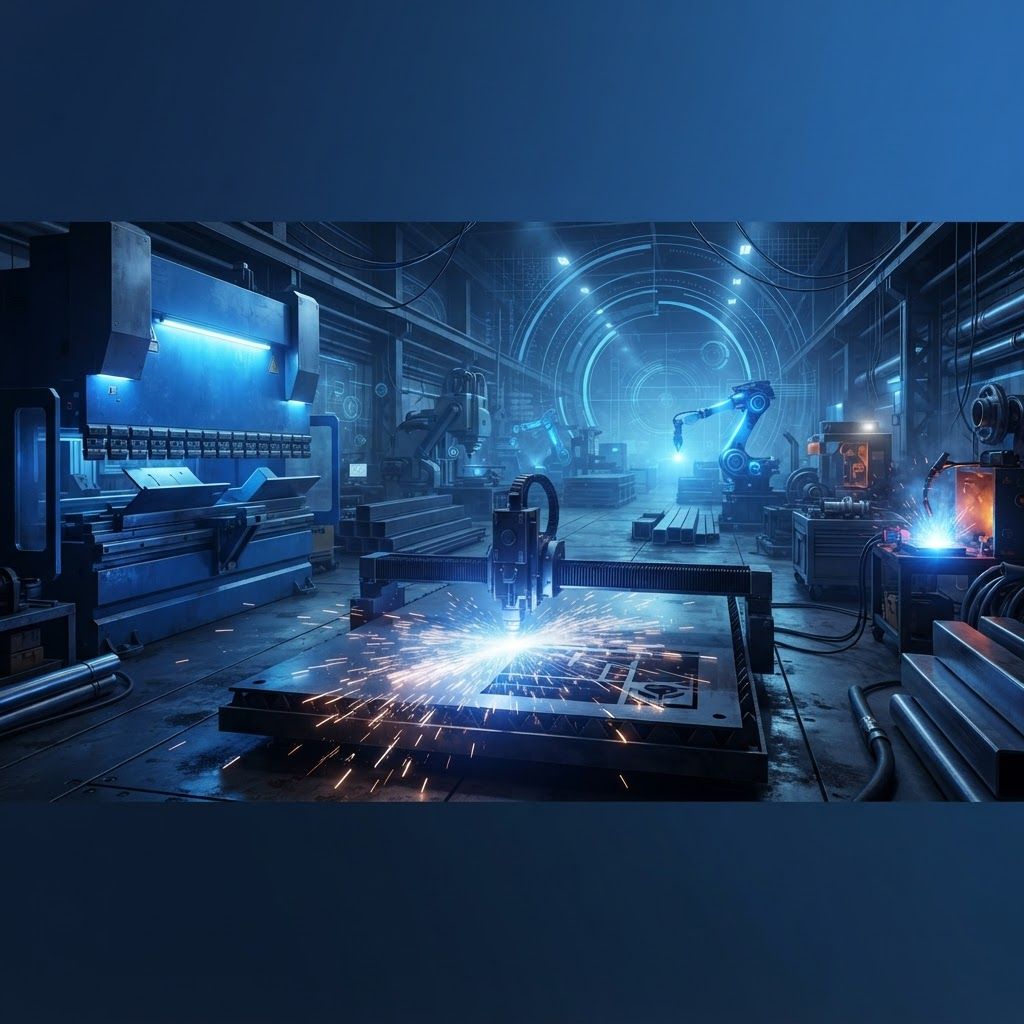
Metalworking in Rochdale: An Engineering Inheritance
Rochdale's engineering tradition grew directly out of textiles. Mills needed machinery, and machinery needed metal — shafts, gearing, frames, castings and countless repair parts. Foundries, machine shops and fabricators established themselves around the mills, and when the textile industry contracted those engineering skills proved transferable. Today the borough supports a broad metalworking sector serving construction, automotive, aerospace, food processing, energy, rail and general industry.
The modern picture is markedly different from the sooty workshops of the past. Fibre laser cutters, CNC press brakes, multi-axis machining centres, robotic welding cells and coordinate measuring machines are now standard in the better Rochdale shops. What has survived from earlier generations is the practical craft knowledge — how a material behaves when it is bent, welded, hardened or ground — that no amount of software fully replaces.
The Leading Metalworks Companies in Rochdale
Rochdale Precision Engineering is among the borough's most respected machining businesses, running CNC turning and milling for components with tight tolerances and demanding surface finishes. Its reputation rests on measurement discipline: temperature-controlled inspection, documented gauge calibration and first-article reports that customers can rely on without re-checking.
Pennine Sheet Metal Fabrication specialises in laser cutting, punching, forming and assembly of sheet metal products including enclosures, panels, brackets and machine guarding. Nesting efficiency and consistent bend accuracy drive both cost and quality here, and the company invests heavily in tooling and programming to control both.
Roch Valley Structural Steelwork serves construction and industrial clients with beams, columns, staircases, walkways and mezzanine structures. Structural work carries significant regulatory weight, requiring certified welding procedures, qualified welders and execution class compliance, and the business is known for its documentation as much as its steel.
Greater Manchester Welding Services operates as a specialist fabrication and repair house, working across mild steel, stainless steel and aluminium with TIG, MIG and orbital processes. Stainless fabrication for food, pharmaceutical and water applications requires particular care over hygienic finishing and passivation, a discipline the company has built its name on.
Milltown Metal Finishing Company handles surface treatment — powder coating, wet spraying, shot blasting, galvanising preparation and anodising support. Finishing is frequently underestimated, yet it determines corrosion life, appearance and customer perception, and poor preparation undoes excellent fabrication.
Heywood Toolmaking and Jigs produces press tools, fixtures, jigs and gauges for other manufacturers. Toolmaking is the discipline behind repeatable production, demanding exceptional accuracy and an intuitive grasp of how components locate and clamp during machining or assembly.
Castleton Laser and Waterjet Cutting offers profiling services across metals and, via waterjet, materials sensitive to heat. Having both technologies locally allows customers to choose the right process for edge quality, thickness and material type rather than compromising on whatever a single supplier owns.
Northern Tube and Pipework Fabrication concentrates on tube bending, pipe spooling and handrail systems for industrial and architectural clients. Bending without distortion or wall thinning takes genuine skill, particularly in stainless and thin-wall sections.
Rochdale Architectural Metalwork bridges engineering and design, producing balustrades, feature staircases, cladding elements, gates and bespoke installations. This work is judged visually as well as structurally, so weld dressing, finish uniformity and installation accuracy all carry unusual weight.
Spotland Machining and Repair Works supports local industry with breakdown machining, shaft repair, keyway cutting and one-off replacement parts. When a production line stops, a nearby shop capable of manufacturing an obsolete part overnight is worth far more than its invoice.
Capabilities and Processes Explained
Metalworking spans several distinct disciplines that buyers often conflate. Subtractive machining removes material to achieve precise geometry, ideal for tight tolerances and complex features. Fabrication cuts, forms and joins sheet or section into assemblies, favouring larger structures at lower unit cost. Forming processes such as pressing and rolling shape material without removing it, efficient at volume once tooling exists. Joining covers welding, brazing, riveting and adhesive bonding, each with different strength, appearance and inspection implications.
Material choice interacts with all of these. Mild steel is economical and easily worked but requires protection from corrosion. Stainless grades resist corrosion at higher cost and with greater machining difficulty. Aluminium offers light weight and good conductivity but demands different welding technique. Tool steels and specialist alloys serve wear and temperature applications. An experienced Rochdale supplier will often propose a material change that reduces cost without compromising function.
Technology and Skills Trends
Automation is advancing steadily. Robotic welding cells improve consistency on repetitive assemblies, automated bending reduces setup variability, and lights-out machining lets shops run unattended overnight. Rather than replacing skilled workers, these systems have shifted skilled roles towards programming, setup and quality assurance.
Digital integration is equally important. Direct import of customer CAD models, offline programming, simulation of tool paths and bend sequences, and digital inspection reporting all reduce errors and speed up quoting. Shops that can turn a 3D model into an accurate quote within a day win work simply by being responsive.
Skills supply remains the sector's principal constraint. Experienced welders, toolmakers and machinists are in short supply nationally, and Rochdale is no exception. The most sustainable businesses run structured apprenticeships and cross-train staff, treating workforce development as a core investment rather than a cost.
How to Select a Metalworks Partner
Define the requirement precisely. Supply full drawings with tolerances, surface finish, material specification, welding requirements and inspection expectations. Vague specifications invite either inflated pricing or unwelcome assumptions.
Match volume to shop type. A precision machining house geared to small batches will price high-volume pressing uncompetitively, and a volume fabricator may have little appetite for one-off repair work. Understanding a supplier's sweet spot benefits both parties.
Verify certification against your sector. General industrial work may need only ISO 9001, while structural steelwork, pressure equipment, rail and aerospace all bring additional standards and welder qualification requirements.
Visit and observe. Material traceability, organised tooling, calibrated measuring equipment, clean welding bays and visible process documentation reveal more about a shop's real capability than any brochure.
Discuss capacity and communication. Ask about current lead times, how schedule changes are handled and who your point of contact will be. Reliable communication when something slips is a stronger indicator of a good long-term supplier than a flawless first order.
Outlook
Reshoring, infrastructure investment and the equipment demands of the energy transition are all generating work for Rochdale's metalworking firms. Those that pair investment in automation and measurement with serious commitment to training will remain competitive, continuing a local engineering tradition that has already outlived the industry that created it.
Want your brand featured in front of decision-makers? Publish a guest post or get a link insertion in our guides through AAMAX's guest post and link insertion service.
Helpful Links
 SponsoredAAMAX — Full-Service Digital Agency
Write for Us
Share your expertise with our readers. We welcome guest contributions from industry specialists.
Pitch your idea