Metalworking: North Lincolnshire's Defining Industry
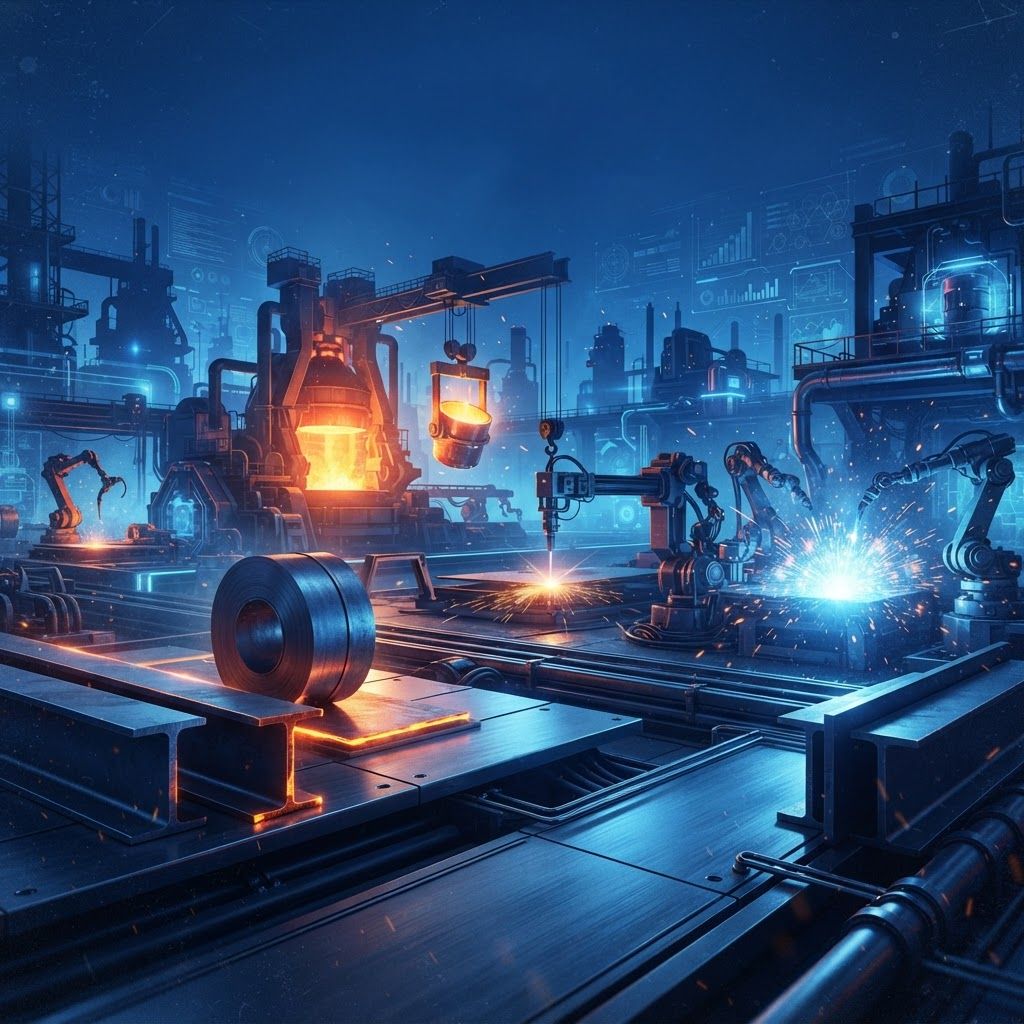
No industry has shaped North Lincolnshire more profoundly than steel. Scunthorpe grew from a collection of villages into a substantial town on the back of local ironstone deposits and the steelmaking industry that developed to exploit them. More than a century later, steelmaking remains central to the district's identity and economy, and it has generated a metalworking ecosystem of genuine depth: heavy fabricators, structural steelwork contractors, precision machinists, sheet metal workers, forging and casting operations, surface treatment providers and specialist welding contractors.
This concentration of capability matters commercially. Metalworking is a skills-intensive sector where competence is built over years, and regions with established clusters retain advantages that are difficult to replicate. North Lincolnshire's metalworking firms serve customers well beyond the district, supplying construction, energy, offshore wind, chemical processing, agriculture, materials handling and transport sectors nationally.
1. British Steel
British Steel's Scunthorpe operation is the anchor of the district's metalworking sector and one of the United Kingdom's most significant industrial sites. The works produce steel sections, rail, wire rod, plate and semi-finished products serving construction, rail infrastructure, engineering and manufacturing markets nationally and internationally. Rail production is particularly notable, supplying track for domestic and export rail networks. Beyond its own substantial workforce, the site sustains an extensive network of engineering, maintenance, haulage and service contractors across North Lincolnshire, making its performance consequential for the whole regional economy.
2. Heavy Fabrication and Structural Steelwork Contractors
Heavy fabricators across North Lincolnshire manufacture structural steelwork, plate girders, tanks, vessels, hoppers, support structures and large industrial assemblies. These businesses operate substantial workshops with heavy lifting capability, plate processing equipment and coded welding capacity. They work to demanding execution standards requiring documented welding procedures, qualified welders, non-destructive testing and factory production control certification. Their proximity to Scunthorpe steel supply and Humber loading facilities is a genuine commercial advantage on large, heavy assemblies.
3. Offshore Wind and Energy Sector Fabricators
Fabricators serving the offshore wind and energy sectors produce secondary steelwork, platforms, access structures, transition piece components and specialist assemblies for renewable energy projects. This work demands rigorous quality systems, marine-grade coating specifications and traceable material certification. The Humber's position at the centre of offshore wind activity has created substantial opportunity for regional fabricators willing to invest in the certification and quality systems the sector requires, and several North Lincolnshire firms have built significant business in this market.
4. Precision Machining and CNC Engineering Firms
Precision machinists across the district operate computer-controlled turning, milling and grinding equipment producing components to tight tolerances. Customers include machinery manufacturers, process plants requiring replacement parts, energy sector suppliers and automotive and aerospace supply chains. A particularly valuable local service is reverse engineering and manufacture of obsolete components, since industrial plant frequently outlives original equipment manufacturer support and a machined replacement often prevents replacing an entire machine.
5. Sheet Metal Fabrication and Laser Cutting Specialists
Sheet metal fabricators provide laser and plasma cutting, punching, folding, welding and finishing of sheet and light plate. Products include enclosures, guards, panels, ducting, brackets and bespoke sheet components. Modern laser cutting has transformed this sector, allowing complex profiles to be produced economically at low volumes with excellent repeatability. For local engineering firms, having quick-turnaround sheet metal capability nearby significantly shortens development and repair cycles.
6. Forging, Casting and Foundry Operations
Forging and casting businesses serving the region produce components requiring the mechanical properties and geometries that these processes deliver. Forged components offer superior grain structure and strength for highly loaded parts, while castings allow complex shapes difficult to machine or fabricate. Applications include machinery components, wear parts, valve bodies and heavy engineering items. These processes require metallurgical knowledge alongside manufacturing capability, and material certification is essential for load-bearing applications.
7. Welding, Cladding and On-Site Metalwork Contractors
Specialist welding contractors provide site-based fabrication, repair, weld overlay cladding and structural modification services to industrial plants across the Humber bank and at Scunthorpe. This work is technically demanding because it is performed in situ, often under access, temperature and time constraints during plant shutdowns. Coded welding qualifications, documented procedures and non-destructive testing are mandatory for pressure-retaining and structural work. These contractors are essential to plant maintenance and turnaround programmes throughout the district.
8. Surface Treatment, Galvanising and Coating Providers
Surface treatment businesses provide shot blasting, galvanising, powder coating, painting and specialist protective coating services. Corrosion protection is critical in the region given the marine and industrial atmospheres of the Humber bank, and coating specification failures cause premature structural deterioration. Providers work to defined surface preparation and coating standards, with inspection of surface profile, coating thickness and adhesion. For steelwork destined for offshore or coastal service, coating quality is a primary determinant of asset life.
9. Steel Stockholders, Processors and Service Centres
Steel stockholders serving North Lincolnshire hold sections, plate, tube, bar and sheet in a range of grades, providing cutting, drilling, profiling and sawing services. Their role is important because it allows fabricators and manufacturers to obtain processed material quickly without holding extensive inventory. Service centre processing, including plate profiling and section cutting to length, removes work from fabricators' own workshops and often achieves better material utilisation through nesting optimisation.
10. Metal Recycling and Scrap Processing Operations
Metal recycling businesses across the district collect, sort, process and supply ferrous and non-ferrous scrap back into steelmaking and metal production. Given Scunthorpe's steelmaking presence and the district's engineering activity, scrap volumes are substantial. Recycling is fundamentally important to steel's environmental profile, as electric arc steelmaking from scrap has considerably lower emissions than primary production from iron ore. As UK steelmaking moves toward electric arc technology, secure scrap supply chains become strategically significant, elevating the importance of this sector.
Standards, Qualification and Quality Assurance
Metalworking operates within a rigorous standards framework. Structural steelwork fabrication requires factory production control certification and execution to defined class requirements, with welding coordination, qualified procedures and certified welders. Pressure equipment carries additional design verification, material traceability and notified body involvement. Non-destructive testing including radiographic, ultrasonic, magnetic particle and dye penetrant examination verifies weld integrity, performed by qualified personnel to documented procedures.
Material traceability is fundamental. Steel must be supplied with mill certification confirming chemical composition and mechanical properties, and this traceability must be maintained through fabrication. For safety-critical and structural applications, the documentation package is as much a deliverable as the physical product.
Skills, Workforce and Succession
Metalworking depends on skills that take years to develop: coded welders, platers, machinists, fitters, inspectors and design engineers. North Lincolnshire's industrial heritage provides an unusually strong foundation in these trades, but demographic pressure is real, with many experienced practitioners approaching retirement.
Apprenticeships remain the primary answer, and firms across the district have expanded intake. The nature of metalworking makes practical training essential, since welding competence, machining judgement and fabrication problem-solving cannot be learned theoretically alone. For young people in the district, these routes offer well-paid, portable and durable careers, and demand from offshore wind, energy infrastructure and industrial maintenance shows no sign of weakening.
Decarbonisation and the Future of Steel
Steelmaking is among the most carbon-intensive industrial processes, and the sector's transition is consequential for Scunthorpe specifically. Pathways under consideration include electric arc furnace production using scrap and direct reduced iron, hydrogen-based direct reduction replacing coal as the reducing agent, and carbon capture applied to existing blast furnace operations.
Each pathway has different implications for energy demand, raw material supply, product range and employment. Electric arc production requires large, reliable electricity supply, which links steel's future directly to the Humber's renewable generation and grid capacity. Hydrogen-based reduction depends on affordable low-carbon hydrogen, connecting steel to the cluster's hydrogen development. This interdependence is precisely why coordinated Humber industrial planning matters so much to North Lincolnshire.
Choosing a Metalworks Partner
Verify certification specifically for the work required, including fabrication execution class, welding qualifications, pressure equipment approval and coating standards. General quality claims are insufficient for structural or safety-critical work.
Assess capacity honestly against your requirement, including lifting capability, workshop dimensions and delivery access for large assemblies. Evaluate design and engineering input, as the best fabricators improve buildability and reduce cost through early involvement.
Check material sourcing and traceability procedures. Discuss inspection and testing arrangements up front, including who performs non-destructive testing and how results are documented. And consider coating and corrosion protection at design stage rather than as an afterthought, since detailing that traps water undermines even excellent coatings.
Final Thoughts
Metalworking is North Lincolnshire's defining industry, rooted in Scunthorpe steelmaking and extending through heavy fabrication, precision machining, surface treatment and recycling. The sector serves construction, energy, offshore wind, chemicals and manufacturing well beyond the district's boundaries, sustained by a depth of skill built over generations. Its decarbonisation challenge is substantial, but the combination of Humber renewable generation, hydrogen development and established engineering capability gives the region a credible path to remaining a metalworking centre of national importance.
Want your brand featured in front of decision-makers? Publish a guest post or get a link insertion in our guides through AAMAX's guest post and link insertion service.
Helpful Links
 SponsoredAAMAX — Full-Service Digital Agency
Write for Us
Share your expertise with our readers. We welcome guest contributions from industry specialists.
Pitch your idea