Metalworking in the Industrial Midlands
Metalworking is arguably the most fundamental of all manufacturing disciplines, and in Hinckley and Bosworth it remains genuinely strong. Situated within the historic industrial belt of the Midlands and close to automotive, aerospace, rail and motorsport customers, the borough supports an impressive concentration of fabricators, machinists, welders, toolmakers and surface finishers.
The work ranges widely. A single industrial estate might house a precision machine shop producing aerospace components to microns, a heavy fabricator building structural steelwork, and a small forge making handmade gates for a country property. This diversity gives local customers access to almost any metalworking capability within a short drive.
Assessment Criteria
Companies were judged on technical capability, equipment and capacity, quality control and inspection, welding and process certification, finishing standards, and reputation for accuracy and on-time delivery.
The Top 10 Metalworks Companies
1. Bosworth Precision Machining — A CNC machining specialist running multi-axis milling and turning centres, producing components to tight tolerance in steel, aluminium, stainless and exotic alloys. Coordinate measuring machine inspection and full dimensional reports accompany deliveries.
2. Hinckley Sheet Metal Works — Handles laser cutting, punching, forming, folding and assembly of sheet metal components, including enclosures, panels, brackets and chassis. Nesting software maximises material yield, which keeps unit prices competitive.
3. Watling Structural Steel — Fabricates and erects structural steelwork for industrial and commercial buildings, including beams, columns, portal frames, mezzanines and staircases, with the execution class certification required for structural work.
4. Sketchley Welding Services — Provides coded welding across MIG, TIG and arc processes in carbon steel, stainless and aluminium. Certified welders and documented procedures support pressure, structural and safety-critical applications.
5. Mallory Tube and Pipe Fabrication — Specialises in tube bending, mandrel work, pipe fabrication and manifold assembly for exhaust systems, handrails, process pipework and motorsport applications.
6. Earl Shilton Surface Finishing — Offers shot blasting, powder coating, galvanising coordination, anodising, plating and wet spray finishing, providing corrosion protection and appearance to a consistent standard.
7. Ambion Architectural Metalwork — Produces balustrades, staircases, gates, railings, canopies and decorative features in steel, stainless and bronze, combining structural competence with genuine design sensibility.
8. Triumph Toolmaking — Manufactures press tools, jigs, fixtures, gauges and specialist cutting tools, the precision foundation on which consistent volume manufacturing depends.
9. Leicestershire Metal Stockholders — Supplies bar, sheet, plate, tube and sections in a wide range of alloys, with cutting and profiling services allowing smaller workshops to buy exactly what they need without holding stock.
10. Bosworth Field Forge and Restoration — A traditional blacksmithing operation producing hand-forged ironwork and restoring historic metalwork, serving heritage properties and clients wanting genuine craft rather than fabricated imitation.
Modern Fabrication Technology
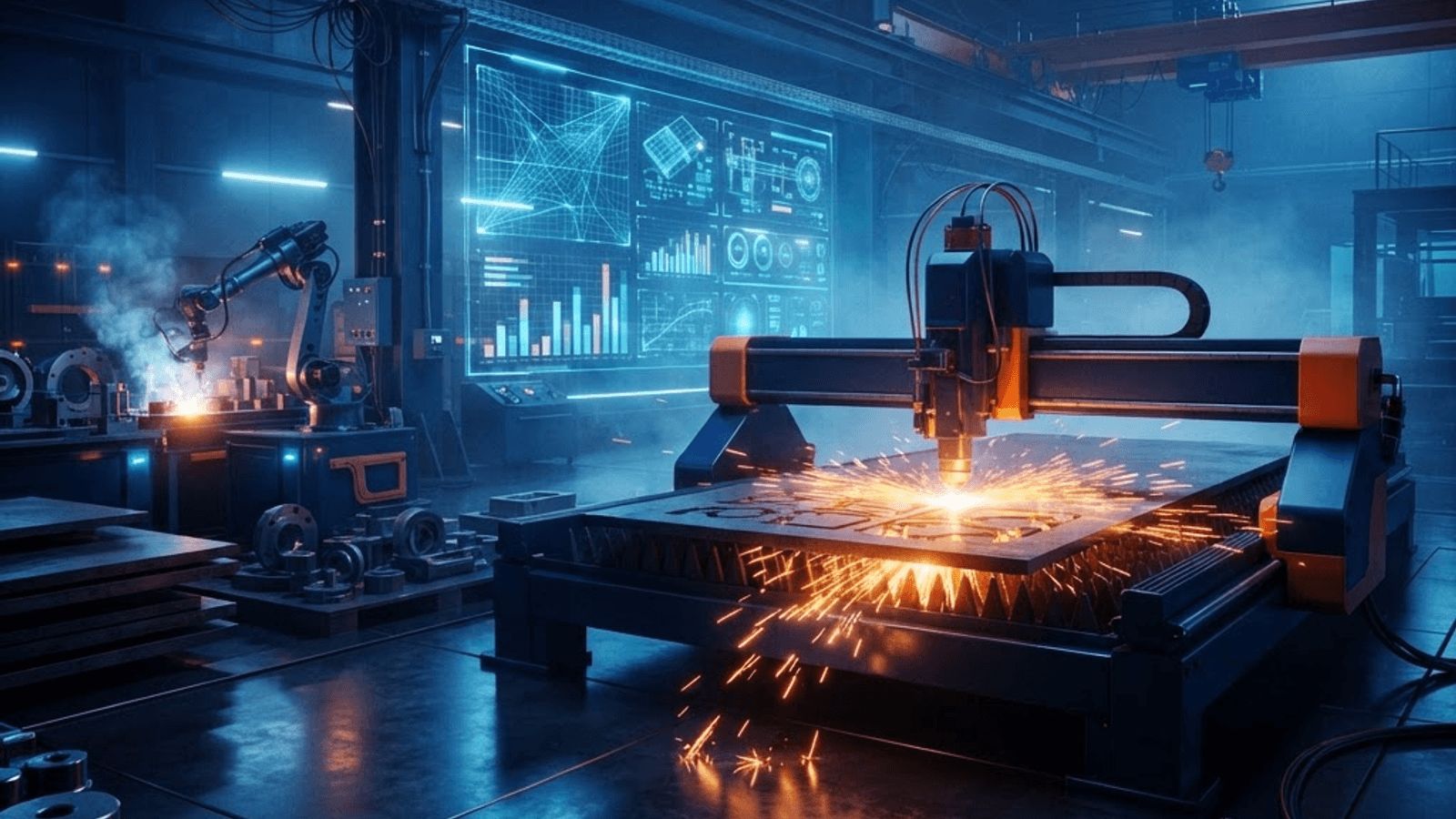
Metalworking has been transformed by technology that has become accessible to workshops of almost any size. Fibre laser cutting delivers exceptional edge quality at high speed. CNC press brakes with automated tool changing handle complex bending sequences repeatably. Robotic welding cells produce consistent welds on repetitive assemblies. Waterjet cutting handles materials and thicknesses that thermal processes cannot.
Digital workflow ties it together. Parts are designed in three dimensions, unfolded automatically into flat patterns, nested for optimal material use and transferred directly to cutting machines. This removes an entire category of transcription error and shortens the path from drawing to finished component dramatically.
Quality, Certification and Traceability
Serious metalwork demands documented quality. Structural steelwork requires execution class compliance and factory production control. Welding for critical applications needs qualified procedures and certified welders. Aerospace and automotive customers require material certificates traceable to melt batch, plus dimensional reporting and process control evidence.
When selecting a supplier, ask what inspection equipment is available and who operates it. A workshop with calibrated measuring equipment, a documented calibration schedule and staff trained to interpret geometric tolerances will deliver consistently. One relying on a tape measure and experience may produce excellent work but cannot prove it, which becomes a problem in regulated supply chains.
Material Selection and Corrosion Protection
Choosing the right metal involves balancing strength, weight, machinability, weldability, corrosion resistance and cost. Mild steel is economical and easily worked but requires protective coating. Stainless steel resists corrosion but costs more and work-hardens during machining. Aluminium offers excellent strength-to-weight but demands different welding technique and joint design.
Corrosion protection is frequently underestimated. For external or humid environments, the finishing specification determines service life as much as the base material. Galvanising, quality powder coating over properly prepared surfaces, and appropriate design detailing to avoid water traps will extend life by decades compared with an inadequate paint finish.
Skills and the Future of the Trade
The sector's principal constraint is skilled labour. Coded welders, CNC programmers, toolmakers and setter-operators are scarce nationally, and the existing workforce is ageing. Companies in the borough that run apprenticeships and invest in progression are the ones maintaining capacity and quality.
Automation partly offsets the shortage but does not eliminate it. Robotic cells and automated machining still require skilled programming, setting and problem solving. The nature of the skill shifts rather than disappears, which makes training investment more important, not less.
Conclusion
Metalworks companies in Hinckley and Bosworth provide capability that underpins construction, manufacturing and engineering across the region. The ten businesses profiled here cover precision machining, sheet metal, structural steel, welding, tube work, finishing, architectural metalwork, toolmaking, stockholding and traditional forging. Whether a project needs a component accurate to a fraction of a millimetre or a hand-forged gate, the expertise exists locally.
Want your brand featured in front of decision-makers? Publish a guest post or get a link insertion in our guides through AAMAX's guest post and link insertion service.
Helpful Links
 SponsoredAAMAX — Full-Service Digital Agency
Write for Us
Share your expertise with our readers. We welcome guest contributions from industry specialists.
Pitch your idea