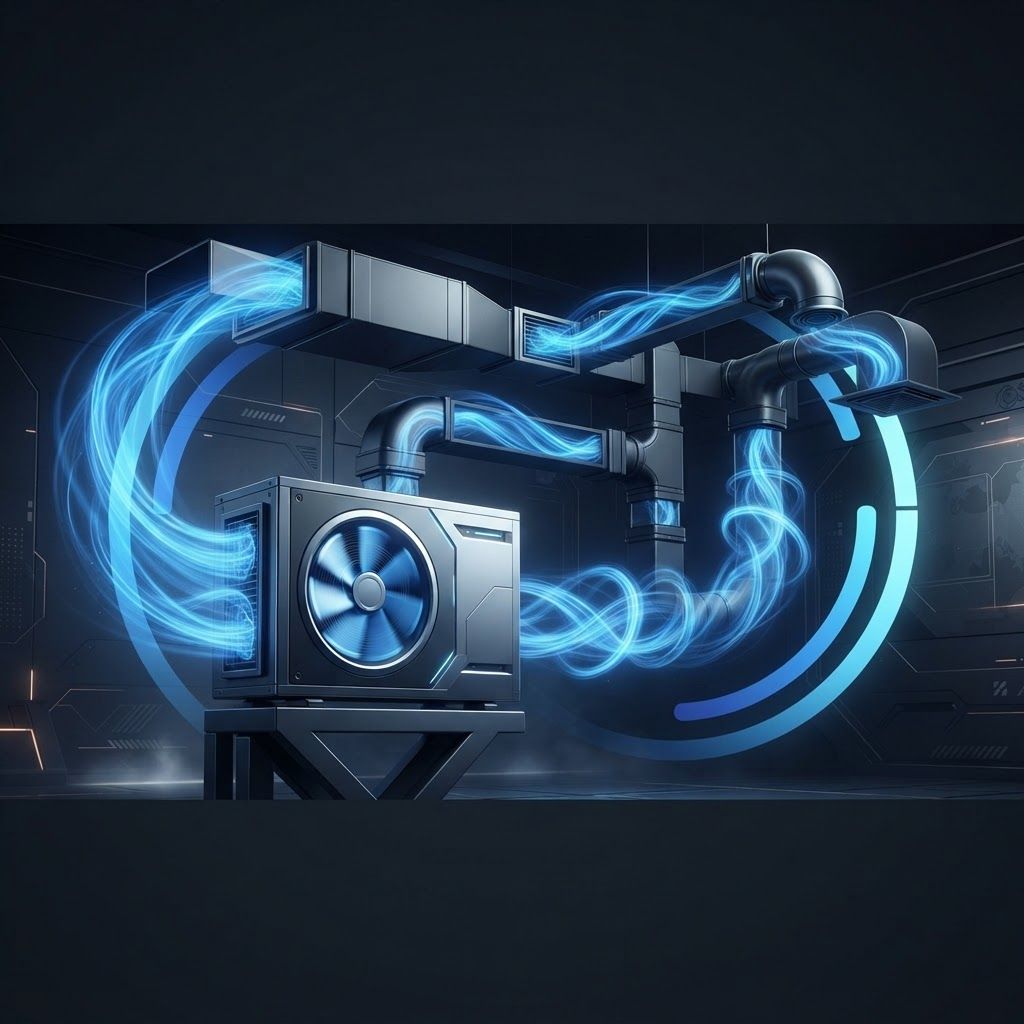
HVAC in a Changing Scottish Market
Heating, ventilation and air conditioning sits at the centre of Scotland's transition to low carbon buildings. For decades, domestic heating meant a gas boiler and radiators, and ventilation meant opening a window. That model is changing rapidly. Scottish Government policy, rising energy costs and tightening building standards are driving adoption of heat pumps, mechanical ventilation with heat recovery, and increasingly cooling provision in commercial and even domestic settings.
West Lothian illustrates the range of demand well. Older properties need heating upgrades alongside fabric improvement. New developments are built to standards requiring careful ventilation design because airtight construction cannot rely on infiltration. Commercial premises in Livingston's business parks require full air conditioning, and data-dependent and clinical facilities need precise environmental control. The categories below reflect this breadth.
1. Air Source Heat Pump Installers
Air source heat pumps are the primary technology for decarbonising domestic heat in Scotland. Certified installers carry out room-by-room heat loss calculation, size the unit accurately, specify emitters capable of operating at lower flow temperatures, select an appropriate cylinder and commission the system for efficient operation. Design quality is decisive: an undersized or poorly designed system delivers inadequate warmth and high running costs, while a well designed one performs excellently even in Scottish winters. Certification under recognised schemes is required for grant eligibility.
2. Gas Boiler and Central Heating Specialists
Gas heating remains the dominant installed system, and Gas Safe registered engineers continue to install, service and repair boilers, upgrade controls and replace radiators. Modern condensing boilers paired with weather compensation and smart controls run substantially more efficiently than older units. Engineers also convert gravity-fed systems to sealed pressurised operation and install magnetic filters and inhibitor to protect against sludge, which is the most common cause of radiator cold spots and pump failure.
3. Air Conditioning Installation and Maintenance Firms
Air conditioning demand has grown in commercial premises and increasingly in homes, driven by warmer summers and by the prevalence of glazed modern buildings. Contractors install split, multi-split and VRF systems, ducted units and cassettes, handling refrigerant work under F-Gas certification. Many modern units provide efficient heating as well as cooling, making them a dual-purpose solution. Regular maintenance including filter cleaning and refrigerant checks maintains efficiency and prevents costly compressor failure.
4. Mechanical Ventilation with Heat Recovery Specialists
Airtight modern construction requires mechanical ventilation to maintain air quality, and MVHR systems provide continuous fresh air while recovering heat from extracted air. Specialists design duct layouts to minimise resistance and noise, commission airflow rates room by room and provide filter maintenance regimes. Correctly designed MVHR delivers excellent indoor air quality and eliminates condensation, which is particularly valuable in the Scottish climate. Poorly designed systems are noisy and ineffective, so design competence matters greatly.
5. Commercial HVAC Contractors
Commercial HVAC firms design, install and maintain building services for offices, retail, industrial and public buildings — air handling units, chillers, boiler plant, ductwork, fan coil units, controls and building management systems. Their work includes plant replacement, energy efficiency retrofits and statutory compliance including air conditioning inspection reports. Planned maintenance contracts are standard, since HVAC failure in commercial premises directly affects occupancy and productivity.
6. Underfloor Heating Installers
Underfloor heating distributes warmth evenly at low flow temperatures, making it an ideal partner for heat pumps. Installers fit wet systems in screed or within joisted floors, and electric systems for smaller areas such as bathrooms. Design considerations include pipe spacing, zone control, floor covering thermal resistance and insulation beneath the system. Underfloor heating also frees wall space and eliminates radiator surfaces, which appeals in contemporary interiors.
7. Ventilation and Extract System Specialists
Beyond whole-house systems, specialists install and maintain kitchen extract, bathroom ventilation, commercial kitchen canopies with grease filtration, industrial fume extraction and dust collection. Commercial kitchen extract requires periodic deep cleaning to manage fire risk, which is both an insurance and a regulatory expectation. In domestic settings, adequate bathroom and kitchen extraction is the single most effective measure against condensation and mould.
8. Refrigeration and Cold Storage Engineers
Refrigeration engineers serve retail, hospitality, food production and healthcare, installing and maintaining walk-in cold rooms, display cabinets, blast chillers, ice machines and process cooling. Reliability is business critical because failure causes immediate stock loss. Engineers work under F-Gas certification, and the sector is transitioning toward lower global warming potential refrigerants, which affects both new installations and the servicing of existing plant.
9. Heating Controls and Smart Systems Specialists
Controls specialists install smart thermostats, zone valves, weather compensation, load compensation and building management systems. Effective control frequently delivers larger savings than plant replacement, because heating only occupied spaces at appropriate times avoids substantial waste. Zoning a house so bedrooms and living areas heat on separate schedules is a straightforward upgrade with a rapid payback, and smart controls add remote operation and usage insight.
10. HVAC Maintenance and Compliance Contractors
Maintenance contractors provide planned servicing, filter replacement, refrigerant leak testing, water treatment, Legionella risk management and statutory inspections. For commercial operators these services satisfy legal duties and protect equipment life. For landlords and homeowners, annual servicing preserves warranty cover, maintains efficiency and identifies developing faults before they cause breakdown during the coldest weather, when engineer availability is most constrained.
Certification and Grants
Verify the relevant certification for the work involved. Gas Safe registration is mandatory for gas appliances, F-Gas certification is required for refrigerant handling, and heat pump installations require accreditation under recognised competence schemes for grant eligibility and warranty validity. Ask for the registration number and check it rather than accepting a verbal assurance.
Scottish Government support for renewable heating and energy efficiency is available through national schemes, typically requiring accredited installers and sometimes an assessment before work. Funding conditions change periodically, and good installers keep current with eligibility criteria and assist with applications, which is a practical reason to choose accredited firms.
Designing for Real Performance
Heat pump performance depends heavily on the building fabric. Improving insulation and airtightness before or alongside installation reduces the required heat pump capacity, lowers capital cost and improves efficiency. Treating fabric and heating as a single project rather than sequential ones produces substantially better outcomes and avoids installing oversized plant.
Insist on documented heat loss calculations, emitter sizing and commissioning results. Systems that are installed but not commissioned properly deliver poor comfort and inflated bills, and without commissioning records there is no baseline against which to diagnose later problems. Reputable installers provide this documentation as standard.
Final Thoughts
West Lothian's HVAC sector spans gas heating, heat pumps, air conditioning, ventilation, refrigeration, controls and commercial building services. As Scotland moves toward low carbon heat, the installers who invest in design competence rather than simply swapping equipment are the ones delivering systems that genuinely perform. Verify certification, address building fabric alongside plant, and demand full commissioning documentation — that is how comfort and low running costs are actually achieved.
Want your brand featured in front of decision-makers? Publish a guest post or get a link insertion in our guides through AAMAX's guest post and link insertion service.
Helpful Links
 SponsoredAAMAX — Full-Service Digital Agency
Write for Us
Share your expertise with our readers. We welcome guest contributions from industry specialists.
Pitch your idea