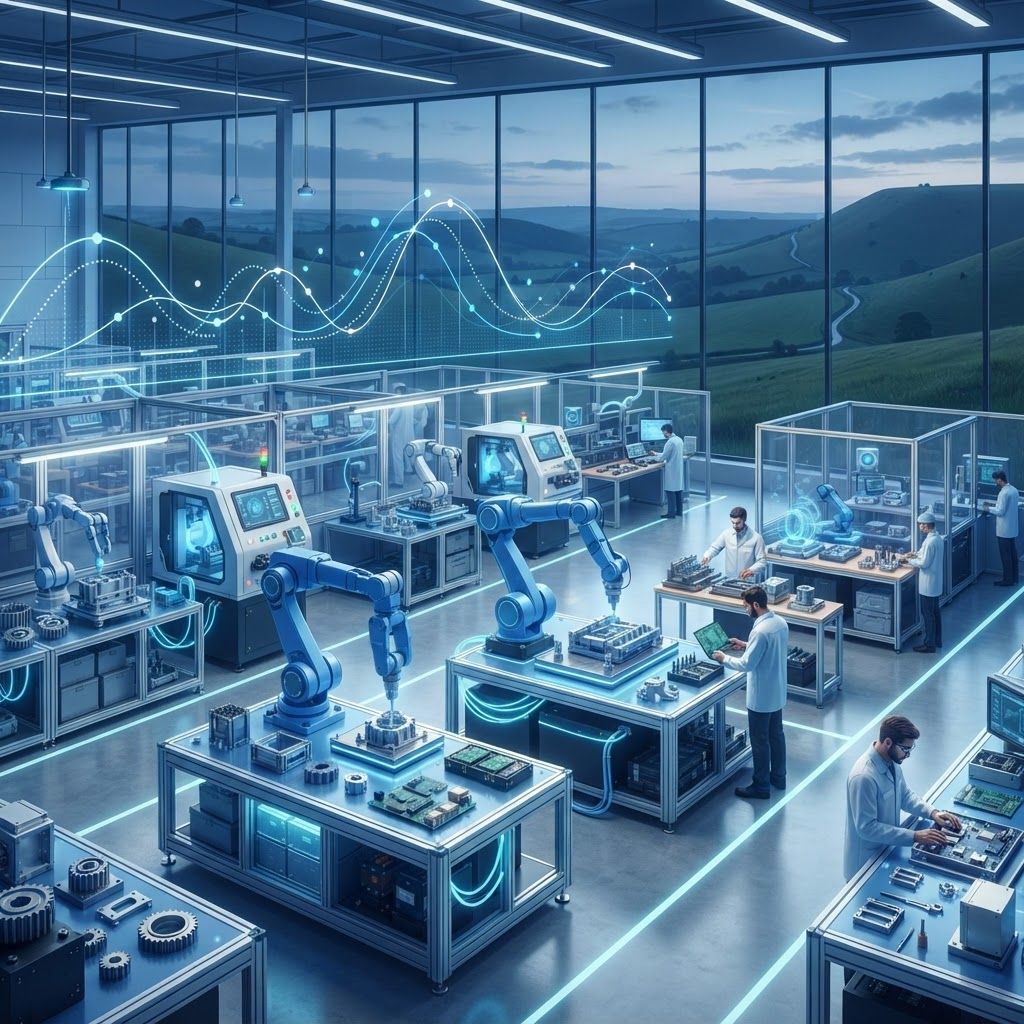
Why the Vale of White Horse Punches Above Its Weight in Hardware
Stretching from Abingdon-on-Thames down through Wantage, Grove, Faringdon and the science campuses at Harwell and Milton Park, the Vale of White Horse contains one of the highest concentrations of advanced engineering employers anywhere in the south of England. The district benefits from an unusual combination of assets: national laboratory infrastructure on its doorstep, a graduate pipeline flowing out of Oxford, and a network of light industrial estates that allow small precision workshops to sit within a few miles of billion-pound research facilities.
The practical result is a hardware ecosystem that spans extremes. On one end sit vacuum chambers, cryostats and particle accelerator components built to tolerances measured in microns. On the other sit high-volume electronic assemblies, sensor modules and enclosure fabrication serving customers across automotive, medical and telecommunications sectors. Buyers in the Vale rarely have to look far for a supplier who understands regulated documentation, first-article inspection and low-volume, high-complexity builds.
How These Manufacturers Were Assessed
The businesses below were considered on engineering depth, quality accreditation, breadth of in-house capability, reputation among local supply chains, investment in automation, and their track record on complex or research-grade work. Emphasis was placed on firms with genuine manufacturing capacity rather than pure design consultancies, and on those whose output is visible in the district's flagship science and industrial projects.
1. Oxford Instruments
No discussion of hardware manufacturing in the area can begin anywhere else. Oxford Instruments builds superconducting magnets, cryogenic systems, plasma etch and deposition tools, and nanoscale analysis instruments used in laboratories worldwide. Its significance to the Vale is twofold: it is a major direct employer of physicists, mechanical engineers and technicians, and it acts as an anchor customer that sustains dozens of smaller machining, sheet metal and electronics subcontractors across Oxfordshire. The company's culture of translating fundamental physics into shippable, serviceable instruments has shaped local engineering norms for decades.
2. Culham and Harwell Precision Engineering Suppliers
Clustered around the Harwell Campus and the wider Didcot–Abingdon axis is a tightly connected group of precision engineering firms that supply fusion, space and synchrotron programmes. These workshops specialise in ultra-high-vacuum welding, exotic alloys, electron beam welding and components that must survive extreme thermal and radiation environments. What distinguishes them is documentation discipline: every weld, heat treatment and dimensional check is traceable, because their customers' experiments cannot tolerate ambiguity.
3. Sharp Laboratories and Milton Park Electronics Manufacturers
Milton Park hosts a broad mix of electronics developers and contract manufacturers producing sensor modules, RF assemblies, control boards and instrumentation. Strengths here include surface-mount assembly for mixed-technology boards, conformal coating for harsh environments, and environmental test capability. Many of these firms specialise in the awkward middle ground between prototype and mass production, where volumes are too low for offshore lines but too high for benchtop assembly.
4. Abingdon Sheet Metal and Fabrication Specialists
Abingdon's industrial estates support several established fabrication businesses offering laser cutting, CNC punching, press braking, powder coating and mechanical assembly. Their value to the district is speed. A research group at Harwell or a machine builder in Wantage can iterate an enclosure, bracket or frame design within days rather than weeks. Increasingly these firms have added in-house design-for-manufacture support, catching costly geometry decisions before tooling is committed.
5. Automotive and Motorsport Component Makers
Oxfordshire's motorsport valley extends into the Vale, and with it comes a family of component manufacturers geared toward lightweight structures, composite bonding, five-axis machining and rapid turnaround. Motorsport work imposes an unusual discipline: parts must be light, strong, inspected and delivered against an immovable race calendar. Those habits transfer well to aerospace and specialist vehicle customers, which is why several of these firms now derive substantial revenue outside racing.
6. Medical Device and Life Science Hardware Builders
The Vale's proximity to Oxford's biomedical research base has produced manufacturers focused on diagnostic instruments, laboratory automation, fluidics assemblies and single-use consumables. Working under quality management systems aligned to medical device standards, these companies combine cleanroom assembly with rigorous change control. Their differentiator is regulatory literacy: they can advise a start-up on design history files and validation strategy long before a product reaches market.
7. Instrumentation and Sensor Manufacturers in Wantage and Grove
Wantage and Grove support a cluster of smaller specialists producing pressure, flow, temperature and optical sensing hardware. Many operate as engineer-owned businesses of ten to sixty staff, offering direct access to the person who designed the product. Customers consistently cite responsiveness and willingness to customise as the reason they stay, in contrast to larger catalogue suppliers that resist deviation from standard specifications.
8. Faringdon Machining and Toolmaking Workshops
Toward the west of the district, Faringdon hosts machining and toolmaking operations serving agricultural equipment, industrial machinery and general engineering markets. These businesses typically run CNC turning and milling alongside conventional machines, allowing them to take on both repeat production runs and awkward one-off repairs. For local manufacturers, this repair capability quietly prevents significant downtime.
9. Renewable Energy and Power Electronics Assemblers
Energy technology has become one of the district's fastest-growing hardware segments, spurred by fusion research and grid innovation programmes based nearby. Firms in this space build power conversion assemblies, battery management hardware, busbars, cabinets and control systems. Compliance with electrical safety and electromagnetic compatibility standards is central to their offering, alongside thermal management expertise that only comes from field experience.
10. Contract Design and Build Engineering Houses
Rounding out the list are integrated design-and-build engineering houses that take a concept from specification through electronics, mechanics, firmware, prototyping and production. For science spin-outs without internal manufacturing, these partners are indispensable. The best of them are candid about cost drivers, propose simplifications rather than accepting every requirement, and plan for serviceability from the first design review.
Trends Shaping Local Hardware Manufacturing
Three shifts stand out. First, supply chain resilience has moved from a procurement footnote to a board-level concern, pushing buyers toward nearby suppliers with visible capacity. Second, automation is spreading into smaller workshops through collaborative robots, automated inspection and pallet-loading systems, allowing modest teams to run extended hours. Third, sustainability requirements are reshaping material choice, packaging and energy use, with customers increasingly requesting carbon data alongside quotations.
How to Choose the Right Manufacturing Partner
Start by being honest about volume and variability, because a workshop optimised for prototypes will struggle with steady production and vice versa. Ask to see quality documentation from a comparable job rather than a generic certificate. Visit the floor: organisation, calibration records and the condition of tooling reveal more than any brochure. Clarify who owns design changes and how they are priced, since ambiguity there causes most disputes. Finally, weigh communication quality heavily, as the cheapest quotation rarely survives the first engineering change.
Final Thoughts
The Vale of White Horse offers something unusual: research-grade engineering capability within a compact, well-connected district. Whether the requirement is a superconducting magnet, a sensor enclosure or a validated medical assembly, there is almost certainly a capable supplier within a short drive. For businesses building physical products, that density of talent is a genuine competitive advantage worth exploiting.
Want your brand featured in front of decision-makers? Publish a guest post or get a link insertion in our guides through AAMAX's guest post and link insertion service.
Helpful Links
 SponsoredAAMAX — Full-Service Digital Agency
Write for Us
Share your expertise with our readers. We welcome guest contributions from industry specialists.
Pitch your idea