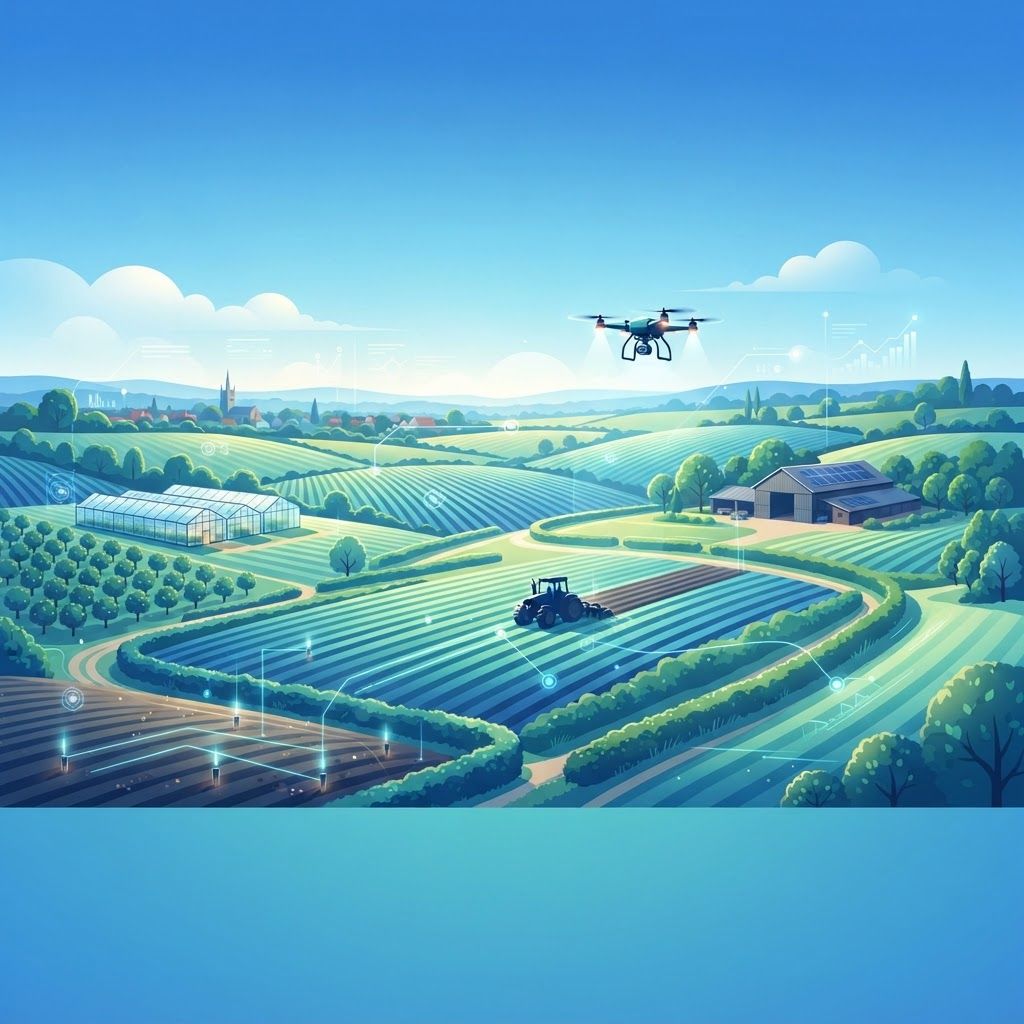
Agriculture on the Edge of the Garden of England
Kent's reputation as the Garden of England was earned through centuries of orchards, hop gardens, market gardens and arable farming, supplying London with fresh food long before refrigerated transport existed. Dartford sits at the meeting point between that agricultural landscape and the capital's expanding urban edge, and farming here has adapted accordingly.
Land around Dartford is valuable and pressured, so successful farming operations tend to be either highly productive on limited acreage, focused on high-value crops, or built around services rather than land ownership. The result is an agricultural sector that is more varied and more entrepreneurial than the traditional image of farming suggests.
Ten Farming Companies Working in and Around Dartford
1. Darent Valley Farms operates mixed arable and livestock production across the valley, growing cereals and maintaining grazing. The business has invested in soil health practices including cover cropping and reduced tillage, improving resilience to both drought and heavy rainfall, which Kent has experienced in recent years.
2. Crayford Market Gardens specialises in salad crops, vegetables and herbs grown for wholesale and direct supply. Proximity to London allows produce to reach customers within hours of harvest, a freshness advantage that distant producers cannot match regardless of scale.
3. Thameside Orchards continues Kent's fruit growing tradition with apples, pears and stone fruit. Modern orchard management, including dwarfing rootstocks, precise pruning regimes and integrated pest management, has substantially increased yield per hectare while reducing chemical inputs.
4. Bluewater Glasshouse Produce grows tomatoes, peppers, cucumbers and soft fruit under protected cultivation. Controlled environment growing extends seasons considerably, and investment in efficient heating, water recirculation and biological pest control has improved both economics and environmental performance.
5. Stone House Livestock raises sheep and cattle on grassland around the borough, supplying local butchers and food businesses. Grazing management on marginal and flood-prone land provides agricultural output alongside genuine habitat value.
6. Joyce Green Agricultural Services provides contracting services including cultivation, harvesting, spraying and baling. Contracting allows smaller farms to access modern machinery without prohibitive capital investment, an increasingly important model as equipment costs rise.
7. Temple Hill Horticulture produces ornamental plants, trees and nursery stock for landscapers, garden centres and developers. Planting requirements attached to new developments have created steady demand for locally grown, well-acclimatised stock.
8. Princes Road Poultry operates free-range egg production supplying local retailers and food businesses. Consumer preference for higher welfare eggs has been one of the clearest shifts in British food buying, and small producers with genuine free-range systems have benefited.
9. Acacia Vineyards reflects one of the most significant developments in Kent agriculture, growing vines for English sparkling and still wine. Warming conditions and chalk soils have made the county genuinely competitive in quality wine production, and viticulture now occupies land that once grew less valuable crops.
10. Hesketh Urban Farming completes the list with vertical growing, hydroponics and controlled environment production aimed at supplying urban markets. Growing intensively in compact spaces close to consumers reduces transport emissions and delivers exceptional freshness, particularly for leafy crops and herbs.
Challenges Facing Local Agriculture
Land pressure is the most obvious constraint. Housing demand across the Thames Gateway competes directly with agricultural use, and land values reflect development potential rather than farming returns. This pushes farming toward higher-value crops and more intensive systems.
Labour availability has been a persistent difficulty, particularly for horticulture, where harvesting remains labour intensive and seasonal. Growers have responded with mechanisation where possible, improved working conditions and crop choices less dependent on peak seasonal labour.
Weather volatility has become a practical planning issue rather than an abstract concern. Drier summers and more intense rainfall events affect irrigation planning, soil management and harvest timing. Water storage and efficient irrigation have moved up the investment list for many Kent growers.
Policy change has reshaped farm economics, with support increasingly linked to environmental outcomes rather than production volume. Farms delivering habitat creation, soil improvement, water quality benefits and public access are being rewarded for work that previously carried no financial return.
Innovation in Kent Farming
Precision agriculture has spread rapidly. Satellite guidance, variable rate application, soil mapping and crop sensing allow inputs to be applied where needed rather than uniformly, cutting cost and environmental impact together.
Regenerative practice has gained genuine traction, with cover cropping, minimum tillage, diverse rotations and reduced synthetic input use aimed at rebuilding soil organic matter. Farmers report improved water infiltration and resilience alongside reduced fuel and fertiliser costs.
Direct selling has grown substantially. Farm shops, box schemes, farmers markets and supply to local restaurants capture more value than commodity wholesale and build direct relationships with consumers who increasingly want to know where food comes from.
Diversification is widespread, encompassing event hosting, glamping, equestrian facilities, renewable energy and workshop letting. These activities stabilise income against volatile agricultural returns and make otherwise marginal holdings viable.
Conclusion
Farming around Dartford operates under real pressure from land values, labour supply and climate variability, yet the sector shows considerable adaptability. Producers here are leaning into their greatest advantage, which is proximity to millions of consumers who value fresh, local, traceable food. Whether through traditional orchards, modern glasshouses, vineyards or vertical farms, agriculture in this corner of Kent continues to earn the county its long-standing reputation.
Want your brand featured in front of decision-makers? Publish a guest post or get a link insertion in our guides through AAMAX's guest post and link insertion service.
Helpful Links
 SponsoredAAMAX — Full-Service Digital Agency
Write for Us
Share your expertise with our readers. We welcome guest contributions from industry specialists.
Pitch your idea