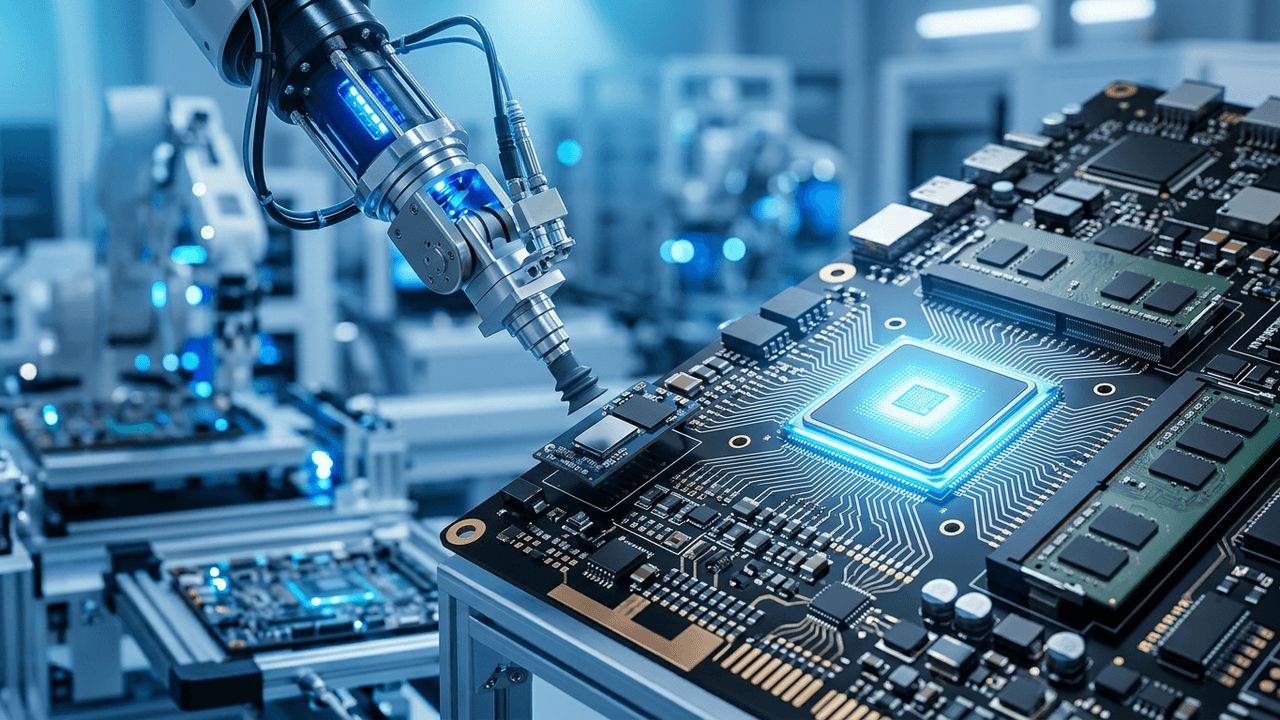
Electronics Manufacturing in Peterborough
Peterborough occupies a strategically valuable position in the United Kingdom electronics landscape. It sits within reach of the Cambridge technology cluster, one of the densest concentrations of semiconductor, embedded systems and hardware design expertise in Europe, while offering substantially lower industrial property costs and better road connectivity for physical goods. The result is a city where design work often happens nearby and manufacturing happens here, supported by a workforce with deep engineering and precision manufacturing experience inherited from the city's heavy industry heritage.
The local electronics sector spans several activities. Electronic manufacturing services providers assemble printed circuit boards and complete products for other companies. Original equipment manufacturers design and build their own instruments, controls and systems. Specialist firms handle cable assembly, wiring harnesses, control panel build, enclosure integration and box build. Test and calibration laboratories support compliance, and a layer of design consultancies provides hardware and firmware development. Together these give Peterborough businesses access to a full route from concept to production without leaving the region.
Understanding Electronics Manufacturing Services
Most companies bringing an electronic product to market use a contract manufacturer rather than building in-house capability. Modern surface mount assembly requires solder paste printing, automated pick and place, reflow soldering under controlled profiles, automated optical inspection and often X-ray inspection for hidden joints such as ball grid arrays. Establishing that capability independently is rarely justifiable below significant volumes.
Good manufacturing partners offer more than assembly. Design for manufacture review catches problems before they become expensive: inadequate pad geometry, insufficient clearance for automated placement, components with poor availability, test point omissions and thermal issues. Component procurement has become a strategic function in its own right following years of semiconductor shortages, and manufacturers with strong supply chain teams, franchised distributor relationships and rigorous counterfeit avoidance procedures protect their customers from both delay and risk. Functional testing, firmware programming, conformal coating, environmental screening and final packaging complete a mature service offering.
Ten Leading Electronics Manufacturers and Partners for Peterborough
Photocentric is a Peterborough-headquartered technology manufacturer that has achieved international recognition for light-based additive manufacturing systems. Its combination of in-house hardware design, chemistry, firmware and volume production is a genuine demonstration of advanced manufacturing capability within the city.
Perkins Engines is central to Peterborough industry, and its electronic control systems, sensors and instrumentation requirements sustain a substantial local supply chain of electronics manufacturers, cable assembly specialists and control panel builders working to demanding automotive and off-highway quality standards.
Cyclops Electronics is a well-established independent distributor of semiconductors and electronic components with strong capability in obsolescence management and hard-to-find parts. During periods of allocation and shortage, distributors of this type become essential to keeping production lines running.
Chemigraphic is a respected electronic manufacturing services provider handling complex printed circuit board assembly and full box build for regulated sectors including medical, industrial and defence. Its quality management systems suit customers who need documented traceability and controlled change processes.
Axis Electronics operates in the East of England providing high-reliability printed circuit board assembly and system build, with particular strength in low to medium volume, high complexity work. That profile fits many Cambridge-designed products manufactured in the wider region.
Escatec and comparable international electronic manufacturing services groups with United Kingdom engineering presence offer a bridge between local design support and offshore volume production, which is often the pragmatic answer for products that begin in low volume and scale rapidly.
Nene Electronics style regional assemblers serve the practical needs of local industrial customers: control panel wiring, sensor looms, bespoke cable assemblies, retrofit electronics and small batch production delivered with short lead times and direct engineer-to-engineer communication.
Sarginsons and similar precision component manufacturers illustrate how mechanical and electronic supply chains intertwine, providing housings, heat sinks and structural components that electronics manufacturers integrate during box build.
Peterborough Embedded Systems type design consultancies provide hardware and firmware development, prototyping and compliance support, helping local companies take an idea through schematic capture, layout, prototype validation and electromagnetic compatibility testing before committing to tooling and volume.
TÜV SÜD and equivalent test and certification bodies complete the ecosystem. Access to competent electromagnetic compatibility, safety and environmental testing is essential for any product entering the market, and proximity to accredited laboratories materially shortens development timelines.
Trends Shaping the Sector
Supply chain resilience remains the defining concern. Companies now design with component availability as a first-order constraint, qualifying alternate parts during development rather than scrambling for substitutes later. Manufacturers that provide transparent, live visibility of procurement risk have a strong competitive advantage.
Reshoring and nearshoring continue to gain ground, particularly for products where intellectual property protection, engineering change responsiveness and total landed cost including freight and inventory carrying favour domestic production. Peterborough benefits directly from this because it offers manufacturing space and skills at costs below the Cambridge or London belt.
Automation and inspection technology keep improving. Automated optical inspection, X-ray, in-circuit test and increasingly machine-learning-assisted defect detection have raised achievable quality levels while reducing labour intensity. Meanwhile, sustainability requirements are extending into electronics through energy efficiency expectations, repairability considerations, restricted substance compliance and end-of-life recovery obligations.
How to Select an Electronics Manufacturing Partner
Match the manufacturer to your volume and complexity honestly. A firm geared to high-volume consumer runs will not serve a fifty-unit instrument build well, and a prototype specialist will struggle at scale. Ask about quality management certification, and for regulated products confirm specific sector accreditations. Request a design for manufacture review on your existing files before placing an order; the quality of that feedback is the single best indicator of engineering competence.
Investigate component procurement practices. Ask which distributors they buy through, how they handle end-of-life parts, whether they offer consignment stock and what their policy is on unauthorised sources. Clarify test strategy: what is tested, at what stage, against what pass criteria, and how failures are recorded and fed back. Establish the process for engineering change, including cost and lead time implications. Visit the facility, look at the shop floor discipline, static control measures and inspection stations, and speak to the production engineer rather than only the sales contact. Finally, agree clear commercial terms on tooling ownership, stock liability and intellectual property.
Conclusion
Peterborough offers a credible and increasingly attractive base for electronics manufacturing, combining proximity to world-class design talent with practical industrial capability and competitive operating costs. From complex regulated printed circuit board assembly to bespoke cable looms and control panels, local and regional partners can support products through the full lifecycle. Companies that select partners on engineering depth, supply chain rigour and quality culture rather than unit price alone will find the region delivers reliably.
Want your brand featured in front of decision-makers? Publish a guest post or get a link insertion in our guides through AAMAX's guest post and link insertion service.
Helpful Links
 SponsoredAAMAX — Full-Service Digital Agency
Write for Us
Share your expertise with our readers. We welcome guest contributions from industry specialists.
Pitch your idea