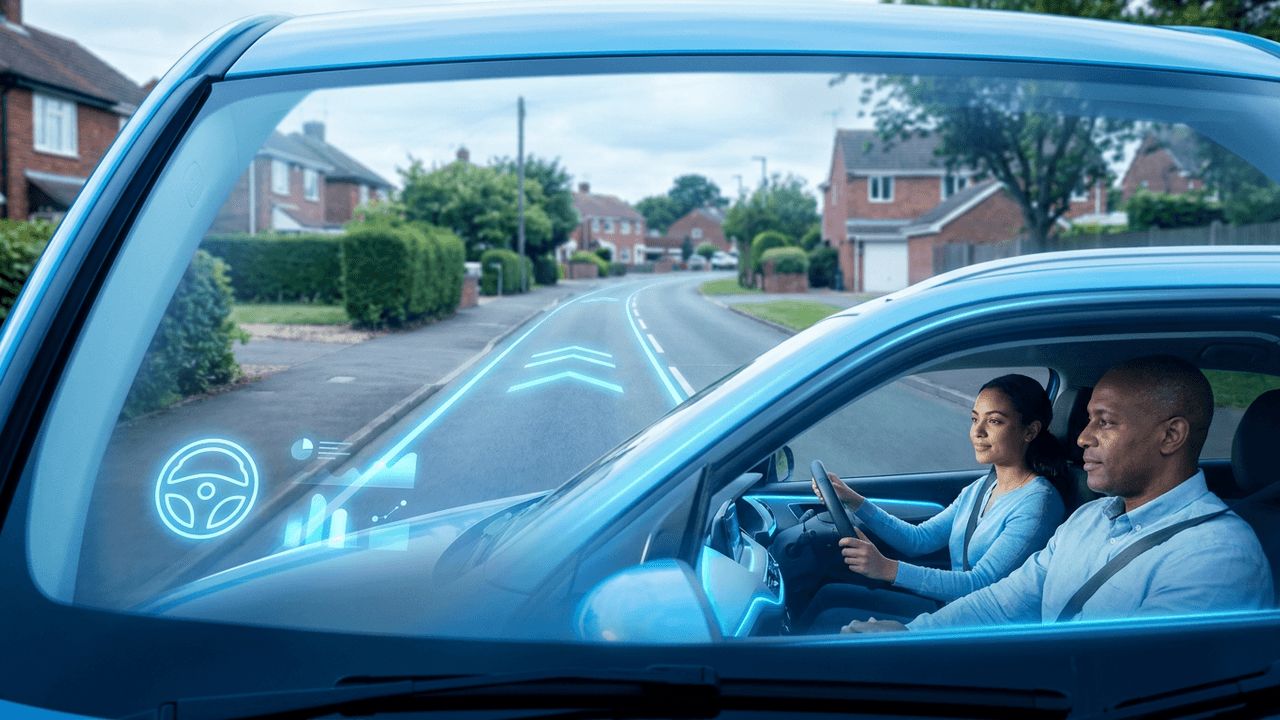
Learning to Drive Where a Licence Really Counts
For young people in King's Lynn and West Norfolk, learning to drive is often less a rite of passage than a practical necessity. Employment on industrial estates, farms and distribution sites is rarely reachable by bus in the early morning. College and university commutes cross the borough. Shift work in food production and healthcare falls outside public transport hours. A licence therefore expands opportunity in a very direct way, which explains the strong demand for quality instruction locally.
Learning here also has distinctive characteristics. Pupils must master narrow country lanes with limited visibility, national speed limit single carriageways, dual carriageway joining on the A47 and A17, agricultural vehicles, flood-prone roads, unlit rural routes at night and the seasonal congestion of coastal towns. Good local instructors build these into their lesson plans rather than teaching only town centre manoeuvres.
1. Established Local Driving Schools
Independent driving schools with long histories in King's Lynn form the core of local provision. Their instructors know the test routes, the commonly used roundabouts and junctions, and the specific hazards examiners look at. Reputation is built on pass rates and word of mouth among families, and many instructors have taught successive generations of the same household. Flexible scheduling and pick-up from home or college adds real convenience.
2. National Driving School Franchises
National franchise networks operate across the borough with standardised training methods, structured lesson plans and progress tracking. Their advantages include consistent teaching frameworks, online booking systems, wide instructor availability so lessons can continue if one instructor is unavailable, and dual-control vehicles maintained to defined standards. Learners who value structure and clear milestone progression often prefer this model.
3. Independent Approved Driving Instructors
Individual approved driving instructors working for themselves offer a highly personal service. Continuity with one instructor throughout the learning journey builds confidence, and self-employed instructors typically have strong incentive to maintain excellent pass rates. Many specialise, whether in nervous learners, mature students or those who have failed a test previously and need targeted rebuilding of confidence.
4. Intensive and Semi-Intensive Course Providers
Intensive course providers compress learning into one or two weeks of concentrated tuition, sometimes with a test booked at the end. This suits people who need a licence urgently for a job offer, students home for a university holiday, or those who already have significant private practice experience. Reputable providers assess suitability honestly rather than selling intensive courses to complete beginners, for whom a longer timeline is usually more effective.
5. Automatic Transmission Driving Schools
Automatic-only instruction has grown substantially, partly because of the shift towards electric and hybrid vehicles that are automatic by design. Learners who struggle with clutch control, those with certain disabilities, and anyone who simply expects to drive automatics can pass more quickly by removing gear changing from the learning load. Local schools offering automatic tuition report strong demand and good pass rates.
6. Theory Test and Hazard Perception Support
Alongside practical lessons, providers offer theory test preparation covering the highway code, question banks, hazard perception clip practice and support for candidates with reading difficulties or English as an additional language. Because the practical test cannot be booked until theory is passed, efficient theory preparation directly shortens the overall journey to a licence.
7. Pass Plus and Post-Test Training Providers
Post-test schemes build on the basic licence with modules covering motorway driving, night driving, rural roads, adverse weather and dual carriageways. For new drivers in West Norfolk this is particularly relevant, since the roads they will use daily include exactly the environments the standard test does not assess. Some insurers offer premium reductions for completing recognised post-test training.
8. Advanced and Defensive Driving Schools
Advanced driving organisations and defensive driving providers train experienced drivers to a higher standard, focusing on observation, planning, positioning and commentary driving. Employers with driving-related roles in logistics, care and utilities increasingly fund this training for staff, and individuals take it for the genuine safety benefit and, occasionally, insurance advantages.
9. Commercial and Vocational Driver Training
Given the importance of haulage, agriculture and construction to the local economy, vocational driver training is an important category. Providers deliver large goods vehicle and passenger carrying vehicle licence acquisition, trailer entitlement, driver certificate of professional competence periodic training, and plant and forklift certification. Many work with employers to train drivers into shortage roles, which has been a persistent regional issue.
10. Specialist and Adapted Vehicle Instruction
Instructors trained to teach disabled learners use vehicles fitted with hand controls, left-foot accelerators, steering aids and other adaptations. Their expertise extends to advising on which adaptations suit an individual and how mobility scheme vehicles can be specified. Alongside this, instructors experienced with anxious learners and those with additional needs such as autism or ADHD use adapted teaching approaches that make a substantial difference to outcomes.
Choosing an Instructor
Confirm the instructor is a fully qualified approved driving instructor rather than a trainee, and ask about their most recent standards check grade. Discuss pass rates but treat any single figure cautiously, since instructors who take on more challenging learners may show lower headline numbers while doing excellent work. Ask how lessons are structured, whether progress records are shared, and what the policy is on cancellations and test-day vehicle use. A trial lesson is the best way to judge whether the teaching style suits you.
Making Faster Progress
Learners who combine professional lessons with regular private practice progress fastest, so arranging insured practice with a family member is worthwhile where possible. Take lessons at varied times, including dusk and in rain, to build genuine competence rather than fair-weather ability. Learn the specific challenges of rural driving deliberately: approaching blind bends, meeting agricultural machinery, dealing with mud and standing water, and judging safe overtakes on single carriageways. Book the theory test early so it does not become a bottleneck.
The Local Outlook
Driving instruction in West Norfolk is adapting to several changes. Automatic and electric vehicle tuition is expanding rapidly, driven by the direction of the wider car market. Digital progress tracking and online booking have become standard expectations. There is greater focus on hazard awareness for rural roads, which carry a disproportionate share of serious collisions nationally. And demand for vocational driver training remains strong as the logistics and agricultural sectors continue to recruit. For learners, the practical message is to choose an instructor who teaches the roads you will actually drive, not just the roads on the test route.
Want your brand featured in front of decision-makers? Publish a guest post or get a link insertion in our guides through AAMAX's guest post and link insertion service.
Helpful Links
 SponsoredAAMAX — Full-Service Digital Agency
Write for Us
Share your expertise with our readers. We welcome guest contributions from industry specialists.
Pitch your idea