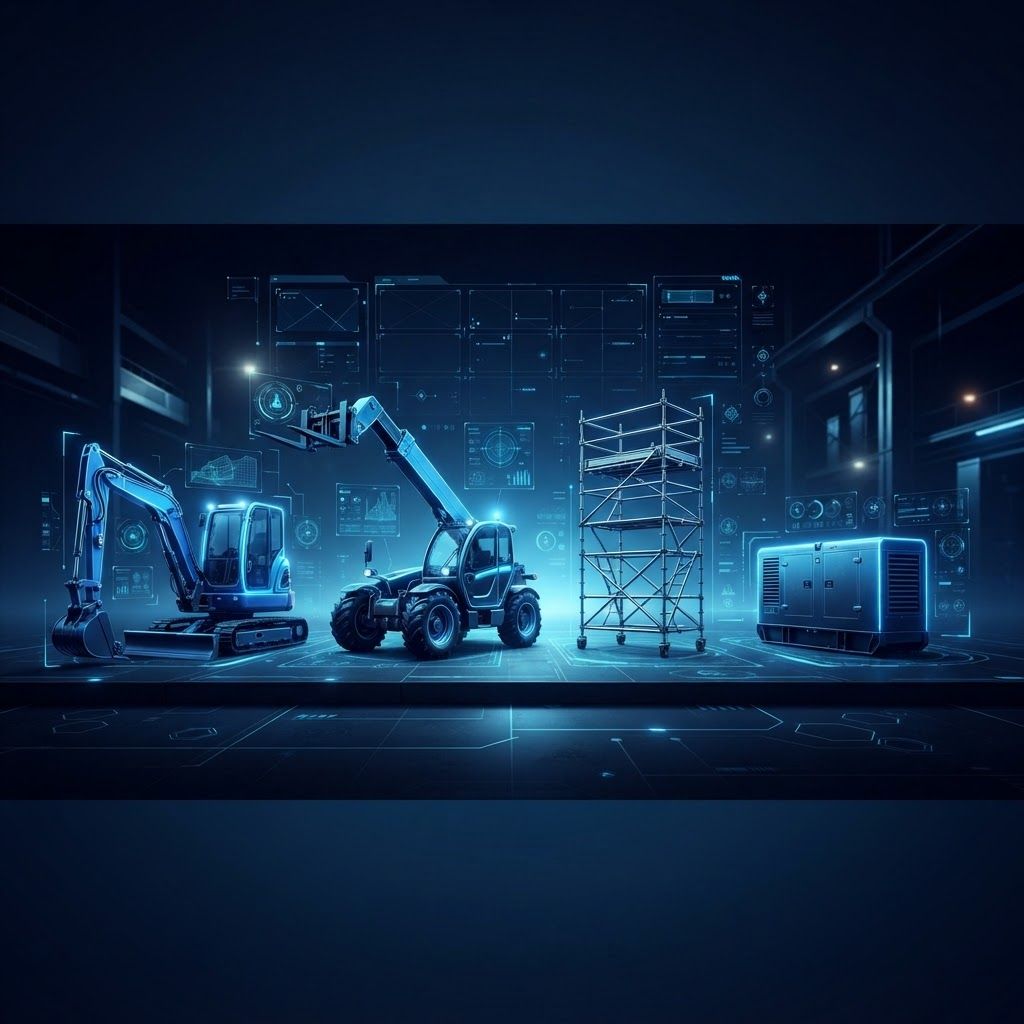
Why Equipment Hire Dominates Construction Access
The construction plant hire model has become fundamental to how building work is delivered. Rather than tying up capital in machinery that sits idle between projects, contractors hire equipment for the period they need it, transferring maintenance, compliance testing, storage and depreciation to the hire company.
For Tendring's construction sector, which is dominated by small and medium contractors alongside a substantial domestic renovation market, this model is particularly important. A local builder undertaking extensions and renovations across Clacton-on-Sea, Harwich, Manningtree and the surrounding parishes needs access to excavators, access equipment, compaction plant and specialist tools without the overhead of owning them.
Homeowners and self-builders benefit equally. Hiring a mini digger for a weekend of groundwork, a scaffold tower for exterior painting, or a floor sander for a renovation project costs a fraction of purchase and delivers professional-grade equipment.
Earthmoving and Excavation Plant
Excavators form the core of groundwork hire. Micro and mini excavators, generally from around one to three tonnes, are the most commonly hired in domestic and small commercial work. Their compact dimensions allow access through standard gateways and side passages, and models with retractable tracks can pass through openings under a metre wide, which is essential for terraced and semi-detached properties in the district's older towns.
Larger machines from five to fifteen tonnes handle foundation excavation, drainage runs, site clearance and bulk earthmoving on development sites. Attachments extend versatility considerably: breakers for concrete demolition, augers for post holes and pile bores, grading buckets for finishing, and grabs for material handling.
Supporting plant includes dumpers for moving spoil, typically one to three tonne site dumpers for confined work, and compaction equipment such as vibrating plates, trench rammers and rollers for preparing subbase and backfilling.
Ground conditions across Tendring affect machine selection. Clay soils become extremely difficult to work when wet and can immobilise tracked machines, while the district's low-lying and alluvial areas may require flotation tyres or ground protection matting. Experienced hire desks advise on this rather than simply supplying the machine requested.
Access Equipment and Working at Height
Access equipment is heavily hired because working at height is both common and strictly regulated. Scaffold towers, available in aluminium sections for straightforward assembly, suit painting, rendering, gutter work and light maintenance. Anyone assembling a tower must be competent, and hire companies typically supply assembly instructions and can provide trained erectors.
Powered access has largely replaced ladders and towers for many tasks. Scissor lifts provide a stable platform for indoor and level-ground work such as warehouse maintenance and ceiling installation. Boom lifts, in articulated and telescopic configurations, reach over obstacles and provide outreach for facade work, tree work and building maintenance. Trailer-mounted and tracked spider lifts serve locations where wheeled access is impossible.
Powered access operation requires appropriate training, and hire companies verify operator qualification before releasing equipment. Harness and fall arrest equipment is typically required in boom lifts.
Telehandlers combine lifting, reach and material handling, and are widely used on residential and commercial sites for moving pallets of blocks, roof trusses and materials to height. Operation requires recognised plant operator certification.
Power Tools and Small Plant
The largest volume of hire transactions involves smaller equipment. Common categories include breakers and demolition hammers, diamond core drills for creating openings through masonry, concrete mixers, floor saws and disc cutters, wall chasers, planers and sanders, and specialist tools such as tile lifters and floor grinders.
Generators and lighting serve sites without mains supply, which is relevant on Tendring's rural and greenfield developments. Site transformers reducing supply to safer voltage are standard practice for tool operation on construction sites.
Pumping equipment deserves specific mention in this district. Given Tendring's flat topography, high water table in places and susceptibility to surface water accumulation, submersible and diaphragm pumps for dewatering excavations are regularly required. Contractors excavating for foundations in low-lying areas should plan for dewatering rather than discovering the need mid-dig.
Site Accommodation, Welfare and Security
Legal welfare requirements mean construction sites must provide sanitary facilities, washing facilities, drinking water, changing areas and rest facilities. Hire companies supply portable toilets, welfare units combining toilet, canteen and drying facilities, site offices, secure storage containers and drying rooms.
Mobile welfare units with integral generators and water tanks have become popular because they require no external services, making them suitable for the rural and remote sites common across Tendring's parishes.
Security equipment including temporary fencing, hoarding, site alarms and CCTV towers protects against theft, which remains a persistent problem in construction. Plant theft in particular has driven adoption of tracking devices and immobilisers across hire fleets.
Specialist and Seasonal Equipment
Beyond general construction plant, hire companies serve specialist needs. Groundworks and drainage contractors hire trench shoring systems, which are legally required to prevent collapse in excavations of significant depth, drain jetting equipment and camera survey kit.
Tendring's agricultural and horticultural sector hires tractors, trailers, chippers, stump grinders and specialist ground care equipment. The district's coastal and marine sector requires pontoons, pumps and equipment suited to tidal working.
Seasonal demand shapes availability. Spring and summer see peak demand for garden machinery, powered access for exterior work and mini excavators for landscaping. Winter increases demand for heating, drying equipment and lighting. Booking ahead during peak periods is essential, particularly for popular items such as small excavators over bank holiday weekends.
Legal Requirements and Operator Competence
Several legal obligations attach to plant hire. Lifting equipment including telehandlers, cranes, hoists and powered access must be thoroughly examined at prescribed intervals, and hire companies provide current examination reports. Users should check these are in date.
Operator competence is a legal requirement. Recognised plant operator certification schemes cover categories including excavators, dumpers, telehandlers, rollers and access platforms. Hire companies serving trade customers generally require evidence of competence for larger plant, and providing equipment to an untrained operator exposes both parties to liability.
Portable appliance testing of electrical equipment, statutory inspection of pressure equipment, and emissions compliance for machinery used in regulated zones all fall within the hire company's maintenance responsibilities but should be verified by the hirer.
Insurance is a critical and frequently misunderstood point. Standard hire terms make the hirer responsible for loss or damage to hired equipment from the moment of delivery. Hired-in plant insurance covers this exposure, and hire companies typically offer damage waiver options. Contractors should confirm their policy covers hired equipment at appropriate value, and homeowners should check whether household insurance extends to hired plant, as it frequently does not.
Hiring Efficiently
Several practices reduce cost and disruption. Assess site access honestly before hiring, measuring gateways, checking overhead clearances and confirming ground bearing capacity, since a machine that cannot reach the work area still incurs charges. Confirm delivery and collection arrangements, as transport is usually charged separately and timing affects the rental period.
Understand the rate structure. Daily, weekly and monthly rates differ substantially in cost per day, and a weekly rate often costs little more than three days. Plan the work programme to align with rate breaks.
Inspect equipment on delivery and record any existing damage with photographs, protecting against disputes on return. Check fuel and consumable arrangements, as refuelling charges can be significant. And return equipment clean, since cleaning charges are commonly applied.
Choosing a Hire Company
Fleet age and maintenance standards are the primary differentiators. Well-maintained, newer equipment breaks down less, which matters far more than a marginal rate difference when a breakdown halts a site. Ask about breakdown response times and whether replacement equipment is provided.
Local depot presence reduces delivery cost and improves response. National chains offer fleet depth and consistent systems; independent local companies frequently provide better service flexibility and technical advice. Many contractors use both, depending on the requirement.
Industry Trends
Electrification is transforming the sector, with battery-powered excavators, dumpers, access platforms and tools entering fleets in response to emissions requirements and demand for low-noise operation in occupied and residential areas. Telematics now track machine location, hours, fuel consumption and fault codes, improving utilisation and enabling predictive maintenance. Digital booking platforms with real-time availability have replaced telephone-only hiring. And hydrogen and hybrid power units are appearing on larger sites as alternatives to diesel generators.
Final Thoughts
Equipment hire gives Tendring's contractors and homeowners access to professional plant without capital commitment, but it rewards preparation. Assess access and ground conditions before booking, ensure operators hold required competence certification, confirm insurance covers hired-in plant, and plan the programme around rate structures. Choose hire partners on fleet condition and breakdown support rather than headline rate, and the equipment will help the project rather than delay it.
Want your brand featured in front of decision-makers? Publish a guest post or get a link insertion in our guides through AAMAX's guest post and link insertion service.
Helpful Links
 SponsoredAAMAX — Full-Service Digital Agency
Write for Us
Share your expertise with our readers. We welcome guest contributions from industry specialists.
Pitch your idea