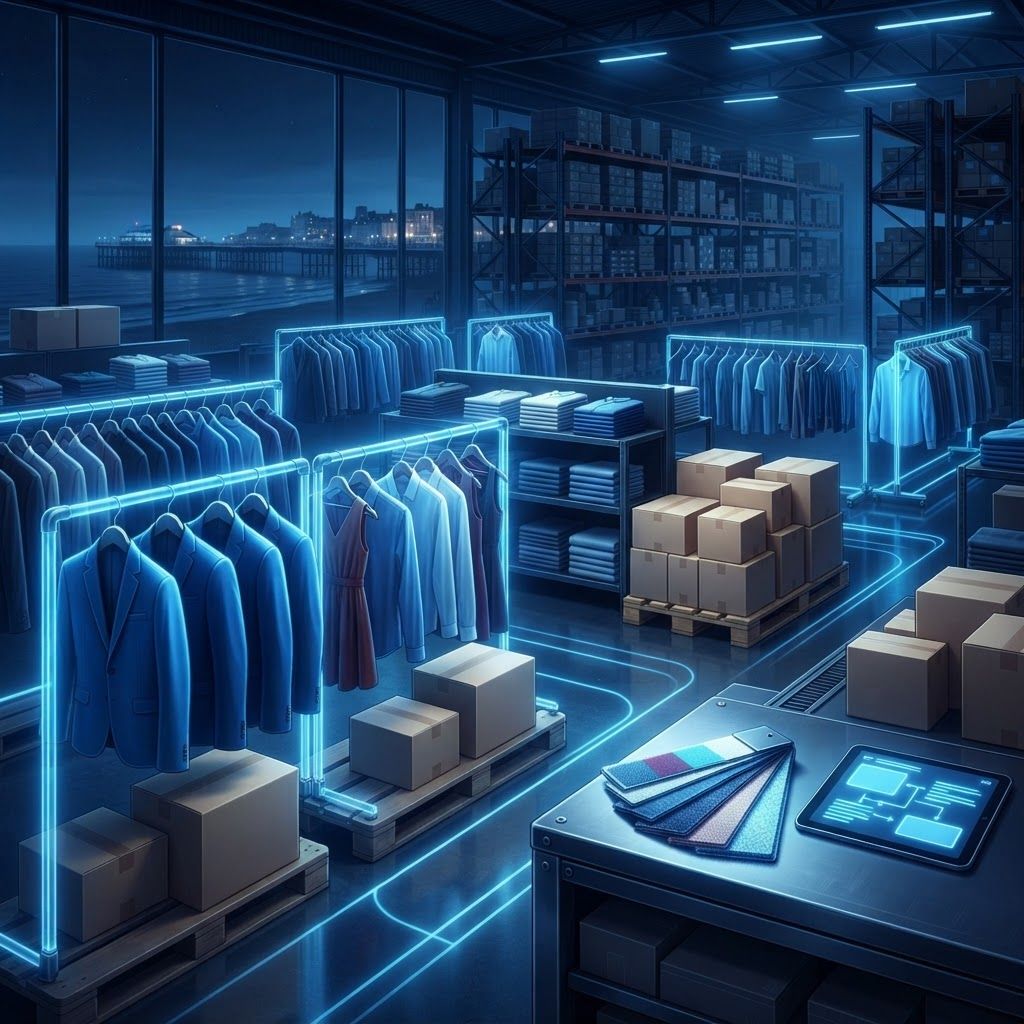
Clothing Wholesale in Southend-on-Sea
Southend-on-Sea has a lively retail character shaped by its High Street, its seafront trade, its market stalls and a growing community of online sellers working from home and small units. Behind all of them sits the clothing wholesale sector: businesses that buy or manufacture apparel in volume and supply it onward at trade prices. For a small retailer, the choice of wholesaler determines margin, stock availability, product quality and ultimately whether the business is viable.
The local and regional wholesale scene covers several distinct models. General fashion wholesalers carry broad ranges of womenswear, menswear and childrenswear, often refreshed frequently to follow trends. Specialist suppliers focus on particular categories such as streetwear, plus sizes, occasionwear, activewear, swimwear or hosiery. Workwear and uniform distributors serve businesses rather than retailers, supplying branded polo shirts, hi-vis garments, chef whites, hospitality uniforms and safety footwear. Blank garment suppliers provide plain t-shirts, hoodies and caps to printers and embroiderers. Clearance and end-of-line wholesalers deal in overstock and cancelled orders at heavily reduced prices.
Who Uses Clothing Wholesalers Locally
Independent boutiques and fashion shops rely on wholesalers to build seasonal ranges without committing to factory minimum order quantities. Buying at trade allows them to test styles in small quantities and reorder what sells.
Online sellers form a fast-growing customer group. Marketplace and social commerce sellers, dropshippers and small e-commerce brands need suppliers offering low minimums, quick replenishment, accurate product imagery and reliable stock data. Some wholesalers now support this segment with data feeds and fulfilment services.
Market traders and event sellers, a long-standing part of the Southend economy, buy volume lines with broad appeal at keen prices. Seasonal seafront trade adds demand for beachwear, sunglasses, light layers and rainwear, with weather driving sharp swings in what sells.
Business buyers purchase uniform and workwear for hospitality venues, care providers, construction firms, schools, logistics operators and retail chains. This segment values sizing consistency, durability, repeat availability of the same style over years, and decoration services such as embroidery and heat transfer printing.
Trends Shaping Apparel Wholesale
Sustainability has moved from optional to expected. Buyers increasingly ask about organic cotton, recycled polyester, responsible wool sourcing, water usage in dyeing and packaging waste. Wholesalers able to supply certified sustainable lines, provide fibre composition details and reduce polybag usage have a competitive advantage, particularly with younger consumers and public sector uniform buyers.
Ethical supply chain transparency has followed. Retailers face reputational risk if garments are traced to poor labour conditions, and larger business buyers now include social compliance questions in tenders. Wholesalers who can name manufacturing countries, describe audit arrangements and reference recognised ethical trading standards are better positioned than those who cannot.
Order flexibility has become a decisive factor. Traditional wholesale relied on large pre-season commitments. Today many suppliers offer small pack quantities, mixed size runs, frequent new arrivals and rapid reordering, allowing retailers to hold less capital in stock and respond faster to demand.
Size inclusivity and gender-neutral ranges have expanded significantly. Extended size offerings, adaptive clothing and unisex fits have moved from niche to mainstream, and wholesalers with genuinely graded patterns across a full size range, rather than simply scaled-up versions of a base size, produce better fitting garments and fewer returns.
Digital wholesale platforms have changed discovery. Online trade portals, virtual showrooms and detailed digital lookbooks now supplement or replace showroom visits, though many buyers still value handling fabric before committing to a range.
Quality, Sizing and Compliance Considerations
Garment quality is judged on fabric weight and composition, seam construction, stitch density, colourfastness, shrinkage after washing, trim quality and print or embroidery durability. Reputable wholesalers provide accurate composition and care information and will supply samples so buyers can assess and wash-test before ordering.
Sizing consistency deserves particular attention. Inconsistent sizing between production batches drives returns and customer complaints. Ask for detailed size charts with actual garment measurements rather than generic labels, and check whether measurements are maintained across reorders.
Regulatory obligations apply too. Textile fibre composition labelling is a legal requirement, care labelling is expected, and childrenswear carries additional safety considerations including restrictions on cords and drawstrings around the neck and hood. Flame retardancy rules apply to nightwear. For protective workwear, garments must meet the relevant standards for hi-vis visibility or flame resistance, with documentation to prove it.
How to Choose a Clothing Wholesaler
Match the supplier to your customer, not to your own taste. Look closely at whether their aesthetic, price architecture and quality level suit the people who actually buy from you. A supplier with beautiful stock at the wrong price point will not help.
Order samples before committing. Assess fabric handle, construction, sizing accuracy and how the garment looks after washing. This modest investment prevents expensive mistakes.
Understand minimums and pack structures. Some wholesalers require full size packs, others allow single-unit picking. Low minimums cost slightly more per item but dramatically reduce risk for new or seasonal lines.
Check stock depth and reorder reliability. Nothing frustrates a retailer more than a best-selling style becoming permanently unavailable. Ask how long core lines are carried and how quickly restocks arrive.
Review commercial terms carefully, including trade pricing tiers, payment and credit arrangements, delivery costs and timescales, and the returns policy for faulty or incorrectly supplied goods. Clarify who bears the cost when a batch has quality defects.
Consider added services. Product photography, data feeds, dropshipping, garment decoration, labelling and stock reservation can all save a small business substantial time and cost.
Conclusion
Clothing wholesalers serving Southend-on-Sea support a diverse customer base spanning boutiques, online sellers, market traders and uniform buyers. The sector is being reshaped by sustainability expectations, supply chain transparency, flexible ordering and digital trade platforms. Retailers and business buyers who sample thoroughly, scrutinise sizing and quality, understand order terms and choose suppliers aligned with their own customers will build stronger margins and more dependable stock positions than those buying on price alone.
Want your brand featured in front of decision-makers? Publish a guest post or get a link insertion in our guides through AAMAX's guest post and link insertion service.
Helpful Links
 SponsoredAAMAX — Full-Service Digital Agency
Write for Us
Share your expertise with our readers. We welcome guest contributions from industry specialists.
Pitch your idea