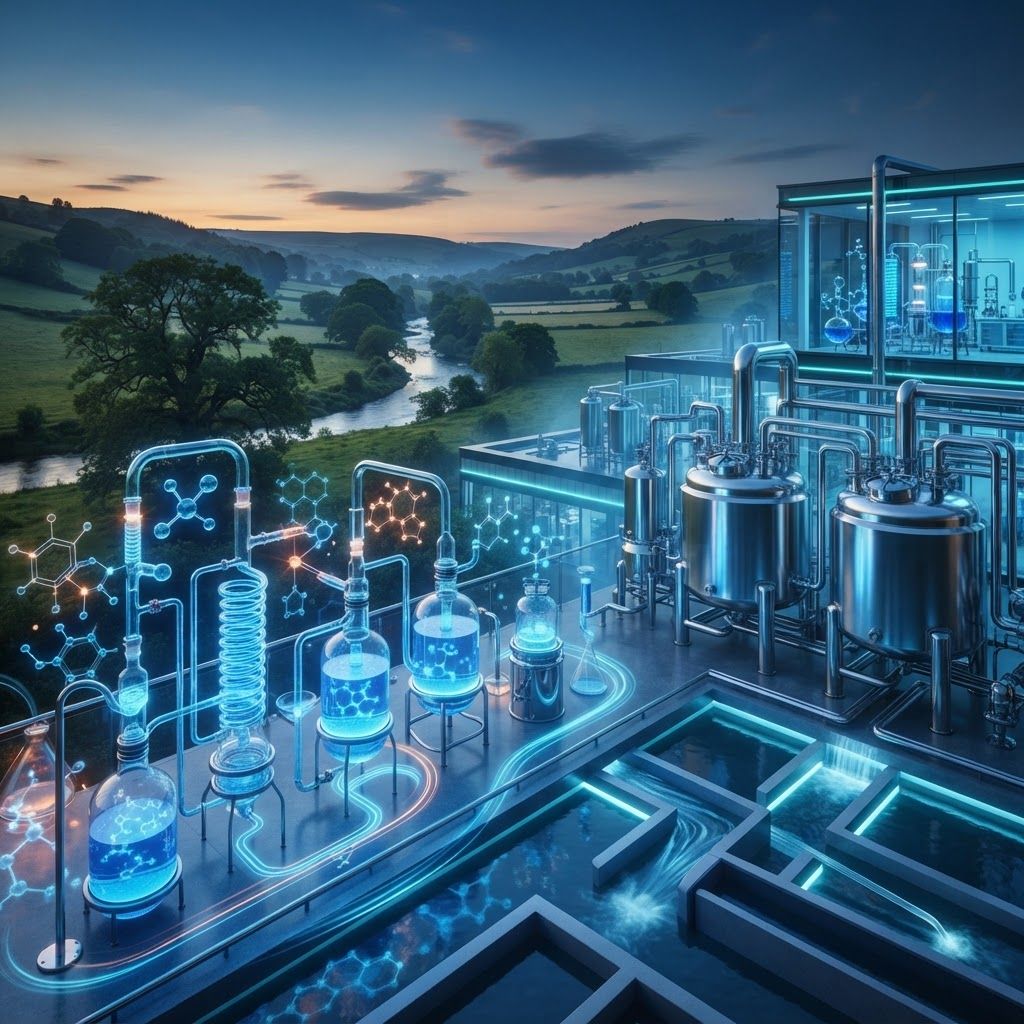
The Chemical Sector in Carmarthenshire
Wales has a well-established chemical industry, historically concentrated around the industrial corridors of the south east and the coastal petrochemical facilities of the west. Carmarthenshire's involvement is more specialised, comprising formulators, blenders, distributors and technical service providers rather than large-scale primary production. This profile suits the county's economy, where agriculture, food processing, water management and manufacturing generate consistent demand for chemical products and expertise.
Typical local activity includes agricultural chemical supply and agronomy, animal health and hygiene products, water and wastewater treatment chemicals, industrial and food-grade cleaning and sanitisation, coatings, adhesives and sealants, laboratory and analytical services, specialty blending and contract packing, and waste treatment chemistry.
Agricultural Chemistry and Agronomy
Agricultural supply is the sector's largest local strand. Suppliers provide fertilisers, crop protection products, seed treatments, grassland and forage additives, silage inoculants, livestock hygiene products and mineral supplementation. Crucially, the better operators supply advice alongside product, employing qualified agronomists who conduct soil analysis, nutrient planning and integrated pest management assessment.
Regulatory obligations here are stringent. Professional users require certification, storage must meet specific standards, application equipment needs periodic testing, and nutrient management is governed by regulations designed to protect water quality. Given Carmarthenshire's dense river network and the environmental sensitivity of its catchments, nutrient management planning has become a central concern for both farmers and their suppliers.
Precision application is increasingly emphasised, with variable rate spreading, targeted spraying and soil mapping reducing both input cost and environmental impact. Suppliers who provide this technical capability deliver measurably better value than those simply selling product by volume.
Water and Wastewater Treatment
Water treatment chemistry supports public water infrastructure, industrial process water, effluent treatment and private supplies. Products include coagulants and flocculants, pH correction chemicals, disinfectants, scale and corrosion inhibitors, and biocides for cooling systems. Food processing operations, dairies, breweries and abattoirs across the county all require effluent treatment to meet discharge consent conditions.
Suppliers in this field typically combine chemical supply with dosing equipment, monitoring instrumentation, sampling and analysis, and process optimisation support. The strongest providers focus on reducing chemical consumption through better control rather than maximising volume sold, which aligns their interests with the customer's operating costs and environmental performance.
Cleaning, Hygiene and Sanitisation
Food and drink production, hospitality, healthcare and agriculture all require rigorous hygiene chemistry. Local formulators and distributors supply detergents, sanitisers, clean-in-place chemicals, foam cleaning products, teat dips and dairy hygiene products, and surface disinfectants tested against recognised efficacy standards.
Technical support is a defining differentiator. Competent suppliers provide dilution control equipment, staff training, verification swabbing, documented cleaning schedules and audit support. For food producers facing retailer and third-party audit, this documentation is as valuable as the chemistry itself.
Regulation and Responsible Supply
Chemical supply operates under a dense regulatory framework covering registration and evaluation of substances, classification, labelling and packaging requirements, safety data sheet provision, transport of dangerous goods, control of substances hazardous to health obligations for users, biocidal product authorisation and, for larger inventories, major accident hazard regulation.
Responsible suppliers make compliance straightforward for customers. That means providing current safety data sheets without prompting, correct labelling in appropriate languages, guidance on storage segregation and containment, advice on personal protective equipment, spill response provision and support with substance inventories and risk assessments.
Environmental stewardship is increasingly prominent. Reducing hazard classification through reformulation, offering concentrated products that cut packaging and transport emissions, providing returnable container schemes and supporting the substitution of substances of concern all indicate a supplier operating to modern expectations rather than minimum legal requirements.
Choosing a Chemical Supplier
Verify regulatory competence first. Ask how the supplier maintains substance registration compliance, whether they hold relevant distribution accreditations and how they manage transport of dangerous goods. Confirm the availability of technically qualified staff rather than purely commercial representatives.
Assess supply reliability, including stockholding, lead times, emergency supply capability and contingency arrangements. For businesses whose operations halt without a specific chemical, single-source dependence is a genuine risk worth managing deliberately.
Evaluate technical service seriously: on-site surveys, application training, monitoring and analysis, troubleshooting support and documentation. In chemical supply, the product is often commoditised while the service is not, and total operating cost frequently depends more on correct application than on unit price.
Finally, consider waste and end-of-life responsibilities. Suppliers who take back containers, advise on disposal routes and support hazardous waste documentation reduce administrative burden and compliance risk for their customers.
Trends Shaping the Sector
Several forces are reshaping chemical supply locally. Regulatory divergence following changes to UK chemical regulation has increased registration complexity for suppliers and importers. Environmental scrutiny of nutrient loading in Welsh river catchments has intensified, driving demand for precision nutrient management and alternative approaches. Interest in biological and bio-based alternatives to conventional chemistry is growing across agriculture and cleaning applications.
Decarbonisation is influencing formulation and logistics, with attention to embedded carbon in raw materials, concentrated product formats and route optimisation. Digital tools for inventory management, dosing control and compliance documentation are becoming standard expectations rather than premium features.
Final Thoughts
Carmarthenshire's chemical companies provide essential technical inputs to agriculture, food production, water management and industry. Choose suppliers who combine regulatory rigour with genuine technical advice, transparent documentation and a demonstrable commitment to reducing environmental impact. In chemical supply, expertise consistently proves more valuable than price alone.
Want your brand featured in front of decision-makers? Publish a guest post or get a link insertion in our guides through AAMAX's guest post and link insertion service.
Helpful Links
 SponsoredAAMAX — Full-Service Digital Agency
Write for Us
Share your expertise with our readers. We welcome guest contributions from industry specialists.
Pitch your idea