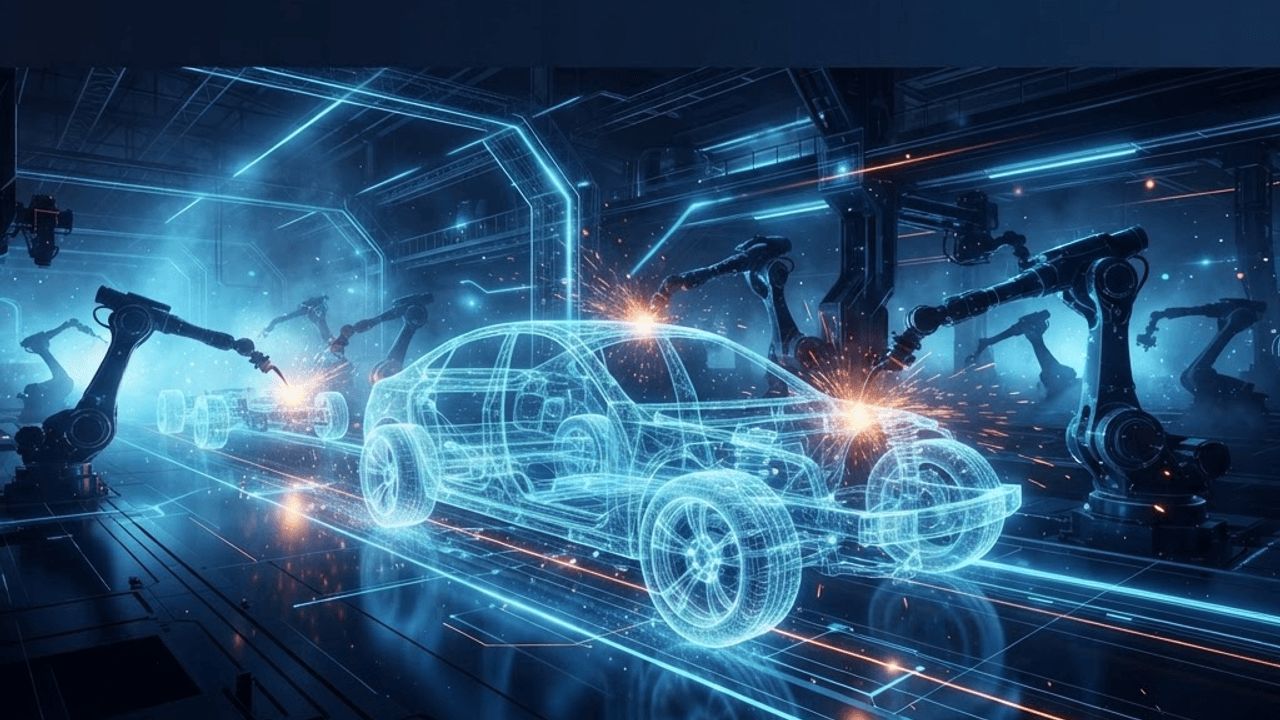
An Automotive District by Any Measure
South Derbyshire's automotive credentials are considerable. Toyota's vehicle manufacturing plant at Burnaston sits on the district's northern boundary and has been one of the region's defining employers for decades. Around it has grown a dense network of component suppliers, logistics operators, tooling specialists and engineering services businesses, many located within South Derbyshire itself or immediately adjacent in Derby, Burton upon Trent and the wider East Midlands.
The district's road network reinforces this position. The A38 and A50 connect directly to the M1, M6 and M42, placing plants within efficient reach of both domestic customers and east coast ports. For a sector built on just-in-time delivery, where a delayed component can halt an assembly line within hours, that connectivity is a structural advantage.
The sector is now navigating the most significant transition in its history. The shift from internal combustion to battery electric propulsion changes the bill of materials fundamentally, alters skill requirements, and redistributes value across the supply chain. How South Derbyshire's automotive businesses adapt will shape the district's industrial economy for a generation.
Ten Automotive Manufacturers With Presence In and Around the District
1. Toyota Manufacturing UK operates the Burnaston vehicle plant producing hybrid passenger cars, supported by its engine facility on Deeside. The plant is widely studied for its implementation of the Toyota Production System, and its supplier development programmes have raised operational standards across the regional supply base.
2. JCB manufactures construction and agricultural machinery from Staffordshire facilities close to South Derbyshire and draws extensively on regional engineering and component suppliers. Its investment in hydrogen combustion technology represents one of the more distinctive decarbonisation strategies in the sector.
3. Alstom brings large-scale vehicle manufacturing discipline to Derby through its rail operations, sharing engineering skills, supplier relationships and manufacturing techniques with the automotive cluster.
4. Rolls-Royce anchors advanced propulsion engineering in the region and provides a pool of high-level engineering capability and precision manufacturing suppliers that automotive businesses draw upon.
5. Unipart Manufacturing supplies complex metal-formed components and fluid handling systems to vehicle manufacturers, with East Midlands operations that serve the regional assembly base.
6. Denso Manufacturing UK produces thermal and powertrain systems for vehicle manufacturers and represents the tier one Japanese supplier presence that followed Toyota's investment into the region.
7. Futaba Industrial UK manufactures pressed and welded body components and exhaust systems, operating in close proximity to the Burnaston plant as part of the just-in-time supply network.
8. Nachi Europe supplies bearings, robotics and precision components used across automotive manufacturing, supporting both vehicle producers and the machinery builders that equip them.
9. Gestamp produces body-in-white structures and chassis components including hot-stamped high-strength steel parts, technology central to meeting crash safety requirements while reducing vehicle mass.
10. Sertec Group manufactures pressings and assemblies for automotive customers from Midlands facilities, serving both traditional and electric vehicle programmes.
The Electrification Transition
Battery electric vehicles contain substantially fewer moving parts than combustion equivalents. Engines, gearboxes, exhaust systems, fuel systems and much of the associated thermal management either disappear or change beyond recognition. For suppliers whose business is built on those components, the transition is existential.
Conversely, new value emerges. Battery pack assembly and enclosures, thermal management for cells, high-voltage cabling and connectors, power electronics, electric drive units and lightweight structures all represent growth categories. Regional suppliers have responded by acquiring capability, retooling presses for aluminium and high-strength steel, and developing competence in high-voltage safety.
Battery production capacity within the UK remains the critical question. Cell manufacturing determines whether vehicle assembly can meet rules of origin requirements for tariff-free export, and by extension whether assembly plants remain viable in the long term. Investment decisions on gigafactory capacity therefore matter enormously to the East Midlands supply base.
Hybrid production, which Burnaston has specialised in, occupies a useful transitional position. Hybrids retain combustion content while adding electric drive, sustaining demand across both supply chains during the changeover.
Supply Chain Pressures and Adaptation
Just-in-time delivery delivered decades of working capital efficiency but proved fragile during recent disruption. Semiconductor shortages, shipping delays and raw material volatility forced widespread reassessment.
The response has been selective rather than wholesale. Manufacturers have identified genuinely critical components and built buffer stock or dual-sourced them, while maintaining lean flow for commodity items. Nearshoring has gained traction where total landed cost including risk favours regional supply, benefiting Midlands suppliers who can demonstrate reliability.
Cost pressure remains intense. Energy-intensive processes such as pressing, casting, heat treatment and paint have been exposed to volatile electricity and gas prices, prompting significant investment in on-site generation and energy efficiency across the district's manufacturing sites.
Skills and Workforce Transition
The workforce challenge is substantial. High-voltage systems require qualified technicians working to specific safety standards, and demand for these skills has grown faster than supply. Software competence has become central as vehicles incorporate more electronic control and connectivity.
Regional training provision has expanded accordingly, with colleges and training providers around Derby and Burton adding electric vehicle content to engineering programmes. Employers have invested in retraining existing staff, recognising that manufacturing discipline and problem-solving ability transfer well even when the specific technology changes.
Outlook for the District
South Derbyshire's automotive future depends on the cluster's ability to move up the value chain rather than compete on cost. The advantages remain real: engineering depth, logistics position, established quality systems and a workforce with generations of manufacturing experience.
Suppliers who have diversified beyond automotive into rail, aerospace, construction equipment and energy have proved most resilient, and that diversification is likely to continue. For the district, the most probable outcome is a smaller but more technically sophisticated automotive base, integrated with adjacent sectors and anchored by the continuing presence of vehicle assembly on its doorstep.
Want your brand featured in front of decision-makers? Publish a guest post or get a link insertion in our guides through AAMAX's guest post and link insertion service.
Helpful Links
 SponsoredAAMAX — Full-Service Digital Agency
Write for Us
Share your expertise with our readers. We welcome guest contributions from industry specialists.
Pitch your idea