Automotive Engineering in South Cambridgeshire
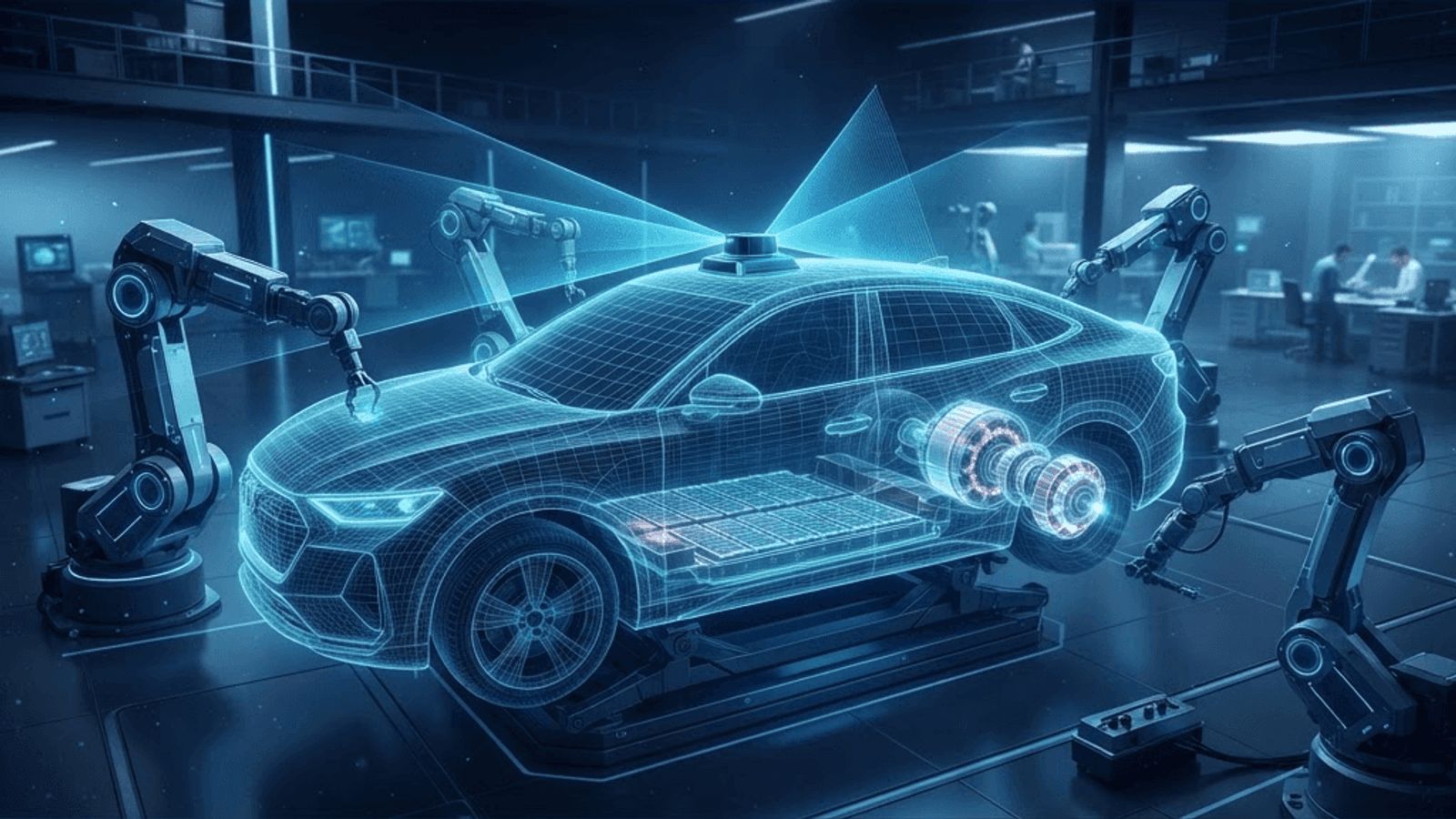
South Cambridgeshire is not a mass vehicle production region, and it never has been. What has developed instead is a concentration of automotive engineering that sits at the technically demanding end of the industry: electric powertrain development, battery systems, autonomous driving software and sensing, lightweight structures and composites, control electronics, and low-volume specialist vehicle manufacture. The district's position within the wider Midlands and East of England automotive corridor, combined with Cambridge research capability in machine learning, materials and power electronics, has made it a natural home for this work.
The transition to electrification has substantially increased the district's relevance. Electric vehicles depend far more on power electronics, thermal management, battery chemistry and embedded software than on traditional mechanical engineering, and these are precisely the disciplines the local economy supplies. Autonomous and driver assistance systems similarly draw on computer vision and sensor fusion expertise that has strong regional roots.
How to Evaluate an Automotive Supplier
Automotive supply carries demanding requirements. Quality management to IATF 16949 is expected for series production, along with familiarity with production part approval processes, advanced product quality planning and failure mode and effects analysis. For safety-related systems, functional safety competence under the relevant automotive standard is essential, and for software, cyber security process compliance is now a regulatory requirement. Assess traceability, change control discipline, and capacity to support both development and production phases. For low-volume and specialist manufacture, individual vehicle approval and type approval experience matters considerably.
The Top 10 Automotive Manufacturers in South Cambridgeshire
1. Granta Electric Powertrain
Developing and building electric drive units, including motors, inverters, transmissions and integrated e-axles, with test cell capability for efficiency mapping, thermal validation and durability testing. Works with both established manufacturers and new vehicle programmes.
2. Duxford Battery Systems
Designing and assembling battery packs and modules, covering cell selection and characterisation, thermal management design, battery management system development, structural pack design and abuse and safety testing to automotive requirements.
3. Shelford Autonomous Vehicle Systems
Producing perception and control systems for automated driving, including sensor fusion across camera, radar and lidar inputs, localisation, path planning software and the validation frameworks needed to demonstrate safe behaviour across operational design domains.
4. Sawston Lightweight Structures
Manufacturing composite and aluminium structural components, including monocoque and chassis elements, body panels and crash structures, using resin transfer moulding, prepreg lay-up and bonded assembly with structural testing validation.
5. Histon Automotive Electronics
Producing electronic control units, sensor interfaces, telematics modules and vehicle networking hardware built to automotive environmental and reliability requirements, with associated embedded software development and compliance testing.
6. Melbourn Specialist Vehicle Engineering
Building low-volume and bespoke vehicles, including conversions, emergency and utility vehicles, research platforms and prototype builds, with type approval and individual approval support for road legality.
7. Papworth Precision Automotive Components
A precision machining and metrology operation supplying tight-tolerance components for powertrain, suspension and braking applications, with coordinate measuring capability and statistical process control on production runs.
8. Cambourne Vehicle Testing & Validation
Providing durability, environmental and electromagnetic compatibility testing, along with instrumented road and track evaluation, data acquisition and correlation between physical test and simulation results.
9. Fulbourn Charging & Vehicle Interface
Developing charging hardware and vehicle-side interface systems, including on-board chargers, communication protocol implementation, bidirectional charging capability and interoperability testing across charging networks.
10. Linton Agricultural & Off-Highway Vehicles
Engineering and manufacturing specialist off-highway machinery for agricultural, horticultural and materials handling applications, including electrification retrofits and autonomous field platforms suited to the district's arable operations.
Electrification and Its Engineering Consequences
Electrification has changed the automotive supply chain profoundly. Component count in the powertrain falls, but complexity migrates to power electronics, software and thermal systems. Battery pack design drives vehicle architecture rather than following it, since mass, packaging and crash protection are dominated by cell placement. Software becomes a safety-critical deliverable requiring rigorous verification and secure over-the-air update capability. Suppliers who previously competed on machining precision now need electronics, software and systems engineering capability, and the companies thriving locally are those that made that transition early.
Autonomy, Software and Regulation
Automated driving development is constrained less by capability demonstration than by validation. Proving safe behaviour across the full range of conditions a vehicle may encounter requires enormous simulation coverage supplemented by targeted physical testing, and regulatory frameworks continue to develop around this. Cyber security and software update regulations now apply to type approval, meaning manufacturers must demonstrate management systems for both, not merely technical measures. Suppliers working in this space need documented processes as much as working algorithms.
Practical Guidance for Buyers
Define the programme phase clearly, since suppliers strong in prototype development are not always suited to series production and vice versa. Confirm quality certification appropriate to the intended volume. Establish intellectual property ownership over development outputs at contract stage rather than later. Agree testing and acceptance criteria quantitatively. Plan compliance and approval activity into the timeline from the outset. And assess supplier financial stability and capacity, since automotive programmes create long-term dependency.
Choosing a Partner
South Cambridgeshire offers automotive engineering capability that is technically deep rather than volume-oriented, and it is particularly well suited to electrification, autonomy and specialist vehicle programmes. Matching supplier strengths to programme requirements, verifying certification and agreeing clear technical and commercial terms remains the most reliable route to a successful outcome.
Want your brand featured in front of decision-makers? Publish a guest post or get a link insertion in our guides through AAMAX's guest post and link insertion service.
Helpful Links
 SponsoredAAMAX — Full-Service Digital Agency
Write for Us
Share your expertise with our readers. We welcome guest contributions from industry specialists.
Pitch your idea