Preston, Leyland and a Century of Vehicle Building
Few place names carry as much automotive weight as Leyland, immediately south of Preston. The town gave its name to one of Britain's most important vehicle manufacturers, and commercial vehicle production continues there today. That legacy shaped the wider district: an established engineering workforce, a network of component suppliers, specialist bodybuilders, and training infrastructure geared towards heavy vehicle and powertrain skills.
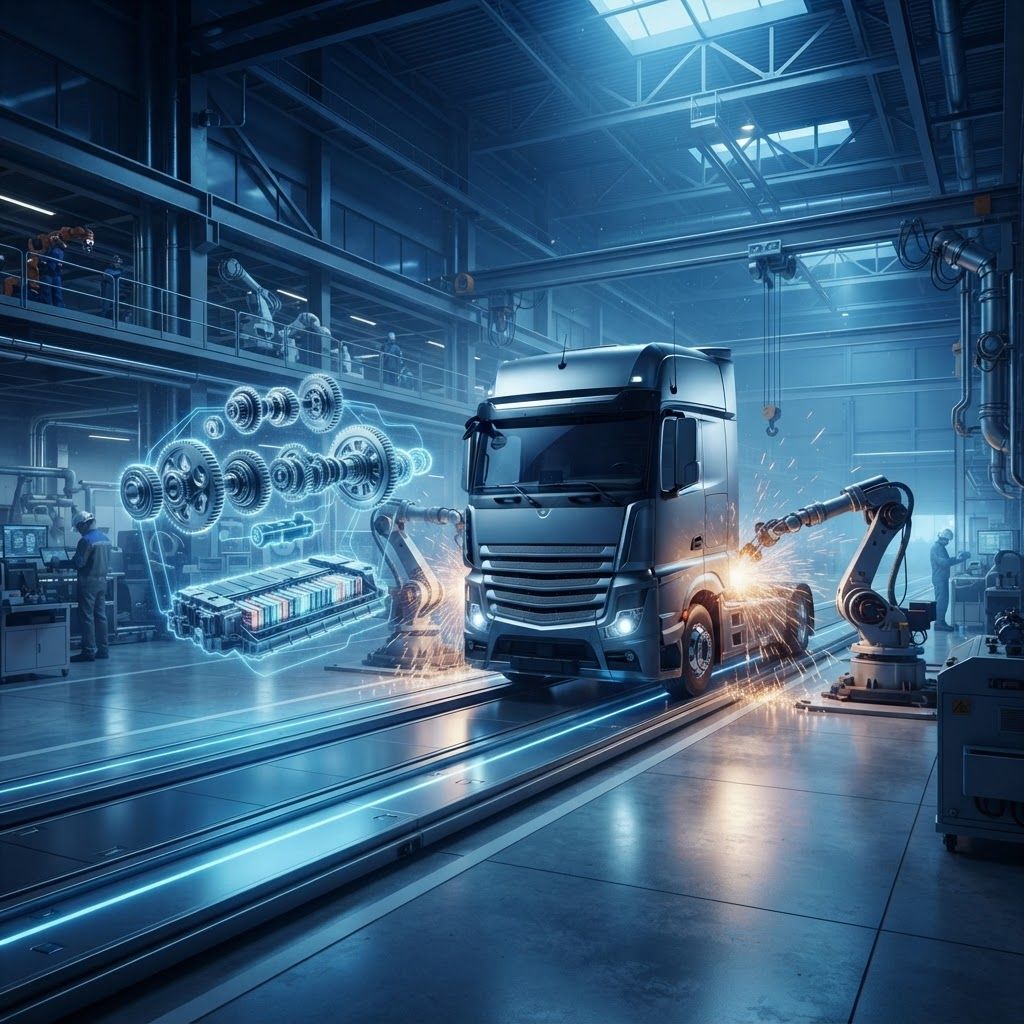
Modern automotive activity around Preston is concentrated in commercial vehicles rather than mass-market cars. Trucks, buses, specialist vehicles, conversions and components dominate, alongside a growing electrification supply chain. This is a favourable position, because commercial vehicle manufacturing depends on engineering customisation and aftersales support, both of which reward local capability.
Ten Automotive Manufacturers and Suppliers
1. Leyland Trucks. The anchor of the district and part of a major global truck group, producing heavy commercial vehicles at Leyland. Its assembly operations, engineering functions and supplier network underpin thousands of jobs across Lancashire.
2. Leyland Motors heritage suppliers and successors. A cluster of businesses descended from the original Leyland supply chain, producing chassis components, axles, brackets, cab parts and fabricated assemblies for vehicle manufacturers.
3. Specialist vehicle converters. Firms building refuse collection bodies, tippers, tankers, curtainsiders, welfare units and emergency service vehicles onto chassis cabs. Conversion engineering is a substantial industry in its own right and demands type approval expertise.
4. Bus and coach builders serving the North West. Manufacturers and refurbishers producing bodywork, interiors and accessibility systems, including electric bus conversions responding to clean air zone requirements in nearby cities.
5. Automotive precision machining businesses. Lancashire engineering firms machining transmission components, hubs, housings, hydraulic parts and fasteners to tight tolerances, often supplying both automotive and aerospace customers.
6. Trailer and towing equipment manufacturers. Producers of commercial and agricultural trailers, coupling systems, load restraint equipment and lifting gear, serving the region's haulage and farming sectors.
7. Electric vehicle powertrain and battery integrators. An expanding group developing battery packs, thermal management, high-voltage wiring and control systems, frequently working on repowering existing commercial fleets as well as new builds.
8. Automotive plastics, composites and trim manufacturers. Suppliers producing injection moulded components, composite panels, interior trim and sealing systems for vehicle assembly and aftermarket replacement.
9. Motorsport and performance engineering specialists. Small high-skill businesses fabricating rollcages, bespoke suspension, engine components and lightweight structures, contributing disproportionate engineering talent to the wider automotive ecosystem.
10. Aftermarket parts and remanufacturing businesses. Operations remanufacturing engines, gearboxes, turbochargers, starters and hydraulic units, which is both commercially attractive and environmentally superior to new manufacture.
What Drives the Local Automotive Economy
Commercial vehicle demand is closely tied to logistics, construction and public sector fleet renewal. Because trucks and buses are configured to customer specification, manufacturing here involves genuine engineering variety rather than repetitive assembly, which sustains higher skill levels than volume car production.
Aftermarket and service activity provides stability across economic cycles. Fleets require parts, maintenance, refurbishment and compliance work regardless of new vehicle sales, so the region's parts distributors, workshops and remanufacturers act as a buffer against downturns.
Component supply links Preston into national and international vehicle programmes. Many Lancashire machining and fabrication firms supply tier one and tier two customers well beyond the region, and their automotive work often coexists with aerospace and industrial contracts, spreading risk.
Trends Reshaping Automotive Manufacturing
Electrification is the defining transition. For commercial vehicles it is more complex than for cars, involving payload and range trade-offs, depot charging infrastructure, battery thermal management and duty cycle analysis. Hydrogen fuel cells remain under active consideration for long-haul and heavy applications where battery mass is prohibitive.
Software content is rising sharply. Telematics, driver assistance systems, fleet management integration and over-the-air updating have turned vehicles into connected assets, requiring manufacturers to develop software and cyber security competence alongside mechanical engineering.
Supply chain regionalisation has accelerated. After significant disruption, manufacturers have increased dual sourcing, shortened supply lines where possible and raised inventory of critical components, which has created opportunities for capable UK suppliers to win work back.
Circular manufacturing is also expanding. Remanufacturing, component recovery and battery second-life applications are becoming formal parts of manufacturer strategy rather than independent aftermarket activity.
How to Choose an Automotive Manufacturing Partner
Verify quality system alignment. Automotive supply typically requires sector-specific quality management certification, documented process control, production part approval processes and measurement system capability. These requirements are demanding and genuinely predictive of supplier reliability.
Confirm type approval and compliance capability for vehicle bodies and conversions. Modifications affecting weight distribution, braking, lighting or structural integrity carry regulatory obligations, and a competent converter manages certification as part of the build.
Assess engineering capacity, not just production capacity. Suppliers able to contribute to design, propose cost-down alternatives and support validation testing are considerably more valuable than those that simply manufacture to print.
Finally, examine capacity and continuity planning. Automotive programmes run for years, so financial stability, succession planning and investment in equipment matter. Ask about recent capital investment and how they handle volume ramp-up.
Final Thoughts
Preston and Leyland remain a serious automotive manufacturing centre, focused on commercial vehicles, conversions, precision components and increasingly electrification. The engineering depth built over more than a century is now being applied to a transition that rewards exactly this kind of adaptable, customisation-oriented capability. For fleet operators and manufacturers seeking engineering-led suppliers, the district offers substance rather than nostalgia.
Want your brand featured in front of decision-makers? Publish a guest post or get a link insertion in our guides through AAMAX's guest post and link insertion service.
Helpful Links
 SponsoredAAMAX — Full-Service Digital Agency
Write for Us
Share your expertise with our readers. We welcome guest contributions from industry specialists.
Pitch your idea