The Case for Repair
The default response to a failed appliance has drifted towards replacement, encouraged by falling headline prices and the convenience of next-day delivery. Yet this default is frequently the wrong choice. A large proportion of appliance failures involve inexpensive components: a pump, a heating element, a door seal, a thermostat, a control board or a drive belt. Replacing these typically costs a fraction of a new machine and restores full function.
The environmental argument is even stronger. Manufacturing a washing machine or refrigerator carries substantial embodied carbon and material extraction impact, and disposal creates waste streams that are difficult to recycle fully. Extending an appliance's life by even a few years measurably reduces its lifetime environmental cost. The growing right to repair movement has begun forcing manufacturers to make spare parts and repair information available for longer, which improves repair viability across the board.
For Warwick households, there is a practical dimension too. Integrated and built-in appliances in fitted kitchens are frequently sized to fit specific apertures, and replacing them can require cabinetry alteration. Repair avoids that cascade of cost and disruption entirely.
When Repair Makes Sense
A useful guideline is to compare repair cost against replacement cost adjusted for remaining life. If the repair costs less than roughly a third to a half of replacement, and the appliance is not near the end of its typical service life, repair is usually the better decision. A five-year-old quality washing machine needing a hundred-pound pump replacement is clearly worth repairing; a twelve-year-old budget machine needing a major bearing rebuild probably is not.
Appliance quality matters in this calculation. Premium machines are generally designed for longer service and have better parts availability, making repair worthwhile later in life. Budget appliances often use sealed assemblies that cannot be repaired economically, effectively designing repair out.
Energy efficiency is a legitimate counter-argument in specific cases. A refrigerator or freezer more than fifteen years old may consume substantially more electricity than a modern equivalent, and the running cost difference can justify replacement even when repair is technically feasible. For washing machines and dishwashers, the efficiency gap between generations is narrower and the embodied carbon argument usually favours repair.
Safety concerns override economics. Appliances with damaged wiring, compromised earthing, gas leaks or structural failure should be replaced or repaired only by qualified engineers, never patched.
Ten Appliance Repair Services Serving Warwick
Domestic and General provides appliance repair and protection plans across a very wide range of brands, with a substantial engineer network and parts logistics. For households wanting cover against future failures rather than reactive repair, its plans provide predictable costs.
Currys repair services handle in-warranty and out-of-warranty repair for a broad brand portfolio, backed by manufacturer relationships that support parts availability and technical information access.
Bosch and Siemens authorised service operating in the Warwickshire area provides manufacturer-trained engineers with genuine parts for these widely owned brands. For appliances still within a warranty period, using authorised service is essential to preserve cover.
Miele service supports one of the most repairable premium appliance ranges, with long parts availability and engineers trained specifically on the manufacturer's designs. Given Miele machines are built for extended service lives, professional repair is almost always worthwhile.
Beko and Hotpoint authorised repairers serving the area cover two of the most common brands in British homes, with established parts supply and standard repair pricing that makes cost predictable.
Glotech Repairs offers multi-brand appliance repair with fixed-price structures and same-day or next-day attendance in many areas, which addresses the disruption a failed appliance causes.
Repaircare provides appliance repair across major brands with transparent diagnostic and repair pricing, along with guarantees on completed work.
Trust A Trader and Which Trusted Trader listed engineers operating in Warwick offer independently reviewed local repair services. For out-of-warranty appliances, independent engineers frequently charge considerably less than manufacturer service while delivering equivalent results.
Independent local appliance engineers with long-established Warwick businesses often provide the best value and the most pragmatic advice, including honest assessments of when repair is not worthwhile. Their willingness to source refurbished parts for older machines can make repairs viable that manufacturers would decline.
Commercial catering equipment specialists in the area serve Warwick's substantial hospitality sector, covering commercial ovens, dishwashers, refrigeration and coffee equipment. This work requires different qualifications and parts access from domestic repair, and using a specialist avoids extended downtime.
Common Faults and Their Causes
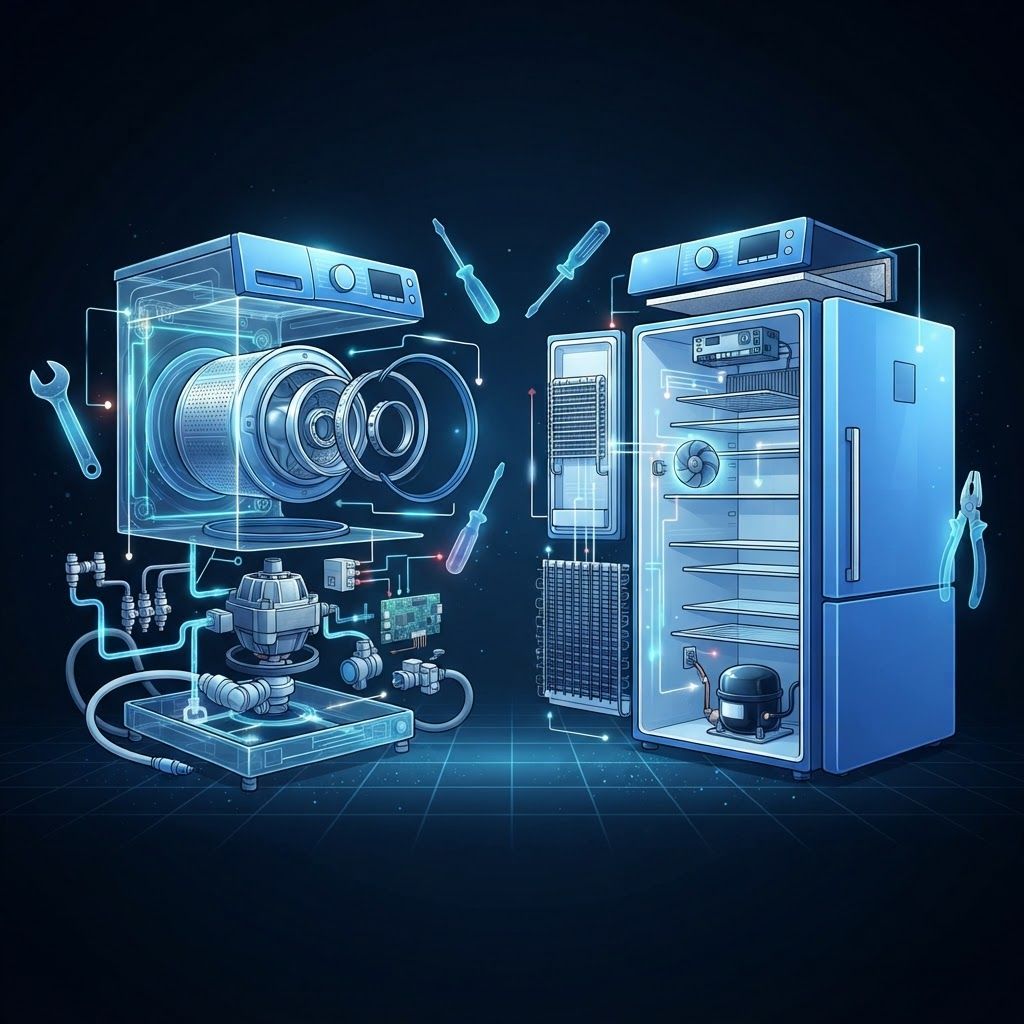
Washing machine drainage failures are usually caused by blocked pumps or filters, frequently by coins, buttons and debris. Regular filter cleaning prevents most of these. Bearing failure, indicated by loud rumbling during spin, is a more substantial repair whose economics depend on machine quality.
Dishwasher performance problems typically stem from blocked spray arms, clogged filters or limescale accumulation, all of which Warwick's moderately hard water accelerates. Using appropriate salt and rinse aid, and running periodic cleaning cycles, prevents much of this.
Refrigeration faults often involve door seals, defrost systems or thermostats rather than the compressor. A failing seal causes overworking, frost build-up and rising energy consumption, and replacing it is inexpensive. Compressor failure, by contrast, is usually terminal economically.
Oven faults commonly involve heating elements, thermostats, fan motors and door seals, all of which are typically straightforward replacements. Inaccurate temperature is frequently a thermostat issue rather than a reason to replace the appliance.
Tumble dryer problems frequently relate to blocked lint filters and condenser units, which reduce efficiency and, in the case of vented models, present fire risk. Regular cleaning is both a maintenance and safety measure.
Extending Appliance Life
Limescale management is particularly important in the Warwick area. Using correct detergent dosing, running periodic descaling or maintenance cycles, and considering water softening where hardness is significant all protect heating elements and internal components.
Loading discipline matters. Overloading washing machines and dryers stresses bearings, motors and suspension. Underloading wastes energy. Following manufacturer guidance genuinely extends service life.
Ventilation and installation conditions affect longevity. Refrigeration needs adequate airflow around condenser coils, which built-in installations sometimes restrict. Appliances need to be level to avoid vibration damage. Adequate clearance behind machines prevents hose kinking and pipe stress.
Cleaning routines prevent a surprising proportion of faults. Filters, seals, dispensers, spray arms and condensers all accumulate residue that eventually causes failure, and periodic attention takes minutes while preventing hours of engineer time.
Commissioning Repair Work
Ask about diagnostic charges and whether they are absorbed into repair cost if you proceed. Confirm whether parts are genuine or compatible equivalents, as this affects both performance and warranty. Establish the guarantee period on completed repairs and whether it covers both parts and labour.
Provide the model and serial number when booking, as this allows engineers to bring likely parts on the first visit rather than returning. Describe symptoms precisely, including when the fault occurs and any noises or error codes displayed, which materially improves first-visit resolution rates.
Conclusion
Appliance repair deserves to be the first consideration rather than the last resort. Warwick is well served by both manufacturer-authorised and independent engineers capable of restoring appliances economically. Combined with sensible maintenance and honest evaluation of repair economics, this approach saves money, reduces waste and avoids the disruption that replacement so often brings.
Want your brand featured in front of decision-makers? Publish a guest post or get a link insertion in our guides through AAMAX's guest post and link insertion service.
Helpful Links
 SponsoredAAMAX — Full-Service Digital Agency
Write for Us
Share your expertise with our readers. We welcome guest contributions from industry specialists.
Pitch your idea