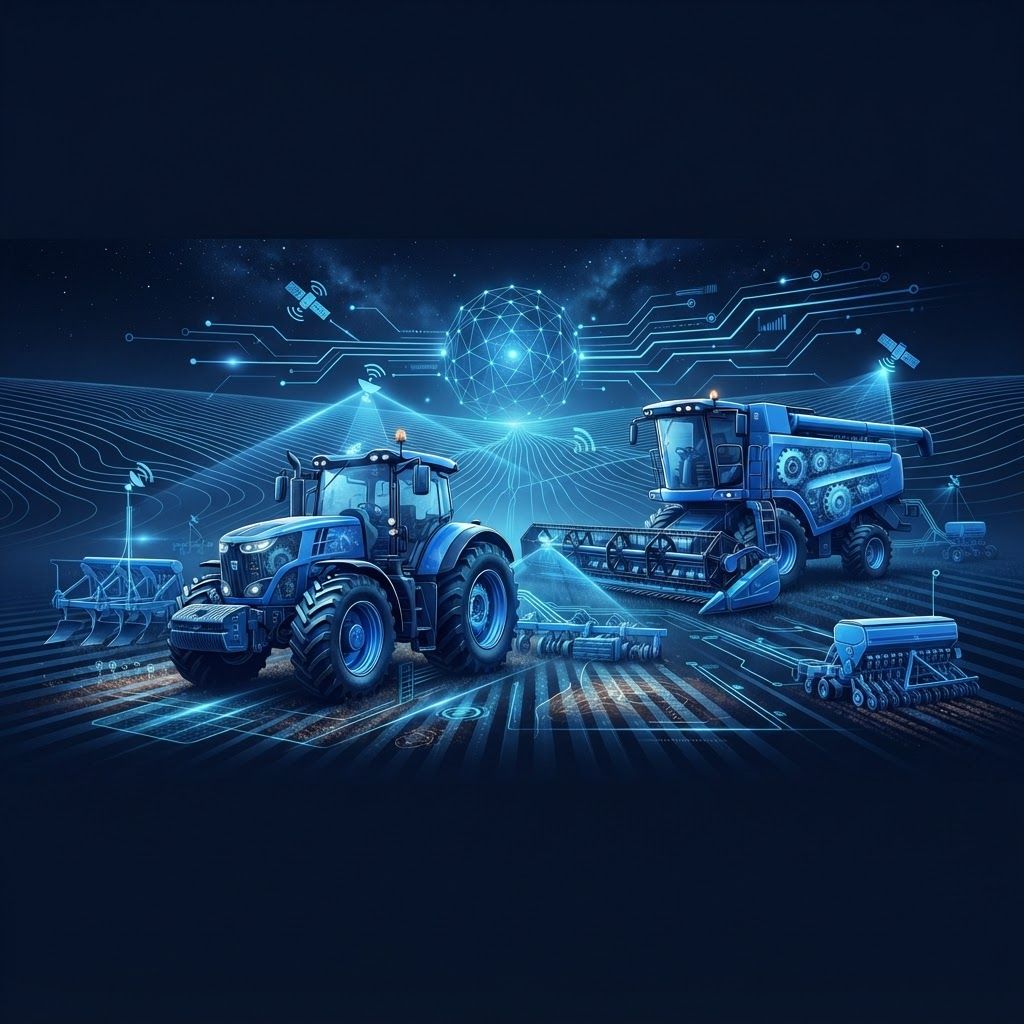
Agricultural Machinery in the Essex Farming Landscape
The farmland surrounding Chelmsford is predominantly arable, dominated by heavy boulder clay soils that demand powerful, well-specified machinery. Working these soils within narrow weather windows requires equipment that combines horsepower, traction and reliability. Add in one of the driest climates in Britain, and timeliness becomes everything: cultivation, drilling and harvest all have to happen when conditions allow.
That environment shapes local machinery preferences. Farmers here tend to prioritise robust build quality, dealer support within reasonable distance, parts availability during harvest, and increasingly the precision technology that allows accurate input placement across variable fields.
Understanding Equipment Categories
Agricultural equipment spans several distinct groups. Tractors provide the power base, ranging from compact machines for smallholdings and estate work to high-horsepower units pulling wide cultivation equipment. Harvesting machinery includes combine harvesters, forage harvesters and balers, representing the single largest capital items on most arable farms. Cultivation and establishment equipment covers ploughs, subsoilers, discs, power harrows and drills, with a marked shift towards minimum tillage systems. Crop protection and nutrition equipment includes sprayers and fertiliser spreaders, where precision directly affects both cost and environmental compliance. Handling equipment such as telehandlers and loaders supports everyday yard work. Finally, precision agriculture technology overlays all of this with guidance, mapping and data systems.
The Leading Agricultural Equipment Brands Available Locally
John Deere maintains a strong presence across Essex arable farms, valued for build quality, resale value and one of the most developed precision farming ecosystems available. Its integrated guidance, documentation and machine connectivity appeal particularly to larger businesses managing data across multiple machines.
Case IH has a loyal local following, especially for high-horsepower tractors and combines. Growers appreciate the transmission options and the straightforward operator environment, and the brand's articulated tractors suit the largest cultivation operations on heavy land.
New Holland offers a broad range spanning compact tractors to large combines, and is often chosen by mixed farms needing versatility across arable and livestock tasks. Its balance of specification and price makes it a common choice for medium-sized businesses.
Massey Ferguson remains widely used, with a reputation for practical engineering and accessible servicing. The mid-range tractors are particularly popular for general farm duties, and the brand's long history in Britain means strong familiarity among operators and mechanics alike.
Fendt occupies the premium end of the tractor market, known for its continuously variable transmission, cab comfort and fuel efficiency. Farms covering long hours find the operator environment and precision control justify the higher initial investment.
Claas is especially strong in harvesting, with combine and forage harvester ranges that perform well in the variable crop conditions Essex growers encounter. Its tractor range has also gained ground locally, supported by comprehensive dealer service.
JCB dominates materials handling on farms through its telehandlers and loaders, which have become essential for grain, bale and general yard work. The Fastrac tractor range also finds use where road speed and versatility matter, such as contracting and sprayer work.
Kuhn supplies implements rather than tractors, covering cultivation equipment, sprayers, spreaders and grassland machinery. Its cultivation range suits the shift towards reduced tillage, and build robustness matters considerably on clay soils.
Amazone is highly regarded for spreaders, sprayers and drills, particularly where application accuracy is a priority. As nutrient management scrutiny increases, precise spreading equipment has become a compliance tool as well as an efficiency measure.
Vaderstad has built a strong reputation for drills and cultivation equipment designed for high output establishment. Growers working large acreages within tight drilling windows value the working speeds and consistent seed placement, both critical on heavy Essex land.
New, Used or Contracted
Machinery represents an enormous capital commitment, and how farms access it varies widely. Buying new offers warranty cover, the latest technology and predictable reliability, but carries the steepest depreciation. Buying used, particularly machines with several seasons remaining, spreads that depreciation and can deliver excellent value where maintenance history is documented. Leasing and contract hire convert capital cost into predictable operating expense, which suits businesses prioritising cash flow certainty.
Agricultural contracting offers a fourth route. Rather than owning a combine used a few weeks each year, many farms buy in harvest, drilling or spraying services. For smaller acreages this is frequently the most rational choice, and it explains the strength of the contracting sector around Chelmsford.
Dealer Support and Parts Availability
Experienced farmers will often say that dealer support matters more than brand badge. A breakdown during harvest can cost a great deal in a single day, so response time, engineer availability, loan machine provision and local parts stock are decisive factors. Before committing to a brand, it is worth asking neighbouring farms about real-world service experience and confirming the nearest depot's parts holding for the specific model.
Precision Technology and the Future
The most significant change in agricultural machinery is not mechanical but digital. Satellite guidance, automatic steering, section control, variable rate application and yield mapping now allow inputs to be matched to field variability with remarkable accuracy. That reduces overlap, cuts input waste and limits nutrient loss to watercourses, addressing cost and environmental objectives simultaneously.
Looking ahead, autonomous and lightweight robotic machinery is progressing from trials towards commercial reality, offering a route to reduced soil compaction and lower labour dependency. Electrification is developing more slowly in high-draught applications, but alternative fuels and hybrid systems are being tested. For Chelmsford farmers, the practical advice remains consistent: choose equipment matched to soil type and acreage, prioritise dependable local support, and adopt precision technology where it demonstrably improves margin.
Want your brand featured in front of decision-makers? Publish a guest post or get a link insertion in our guides through AAMAX's guest post and link insertion service.
Helpful Links
 SponsoredAAMAX — Full-Service Digital Agency
Write for Us
Share your expertise with our readers. We welcome guest contributions from industry specialists.
Pitch your idea