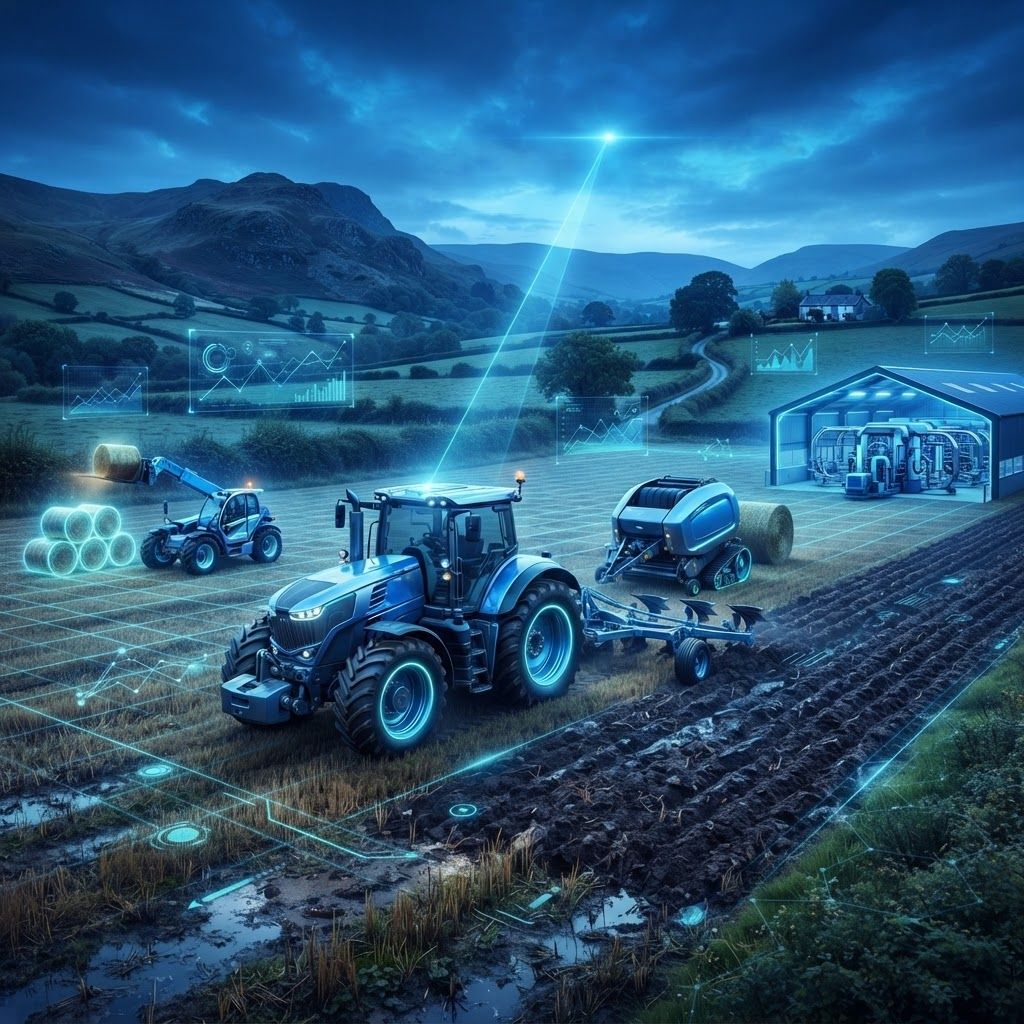
Machinery That Has to Work When It Matters
Agricultural equipment in Carmarthenshire faces genuinely demanding conditions. High rainfall means wet ground and short weather windows for silaging. Steep valley sides and upland grazing demand stability and traction. Dairy operations run equipment twice daily every day of the year with no tolerance for downtime. When a forage harvester stops mid-silage or a milking parlour fails at five in the morning, the cost is immediate and substantial.
That reality shapes the local equipment market profoundly. Farmers here buy on serviceability, parts availability and dealer response time at least as much as on specification or price. A brand with an excellent machine but a distant dealer struggles against a solid machine supported by an engineer who answers the phone at six in the morning and carries the right parts in the van.
The county's equipment needs reflect its farming mix. Dairy dominance drives demand for milking technology, slurry handling, forage machinery and feeding equipment. Beef and sheep enterprises need handling systems, trailers, mowers and fencing equipment. Contractors require high-capacity harvesting, spreading and cultivation machinery. Smallholders and part-time farmers need compact, affordable kit.
Categories of Agricultural Equipment
Tractors and telehandlers form the backbone, with power requirements spanning compact yard machines to high-horsepower contractor units.
Grassland and forage machinery covers mowers, tedders, rakes, balers, wrappers, forage harvesters and silage trailers.
Slurry and manure handling includes tankers, umbilical systems, dribble bars, trailing shoes, separators and agitators — an area transformed by nutrient regulation.
Dairy and milking equipment spans parlours, robotic milking units, bulk tanks, cooling, cleaning systems and heat recovery.
Livestock handling covers crushes, races, weighers, gates, feed barriers and housing systems.
Cultivation and reseeding includes ploughs, power harrows, drills, rollers and grassland harrows.
Fencing and land management covers post drivers, wire strainers, hedge cutters and toppers.
Precision technology encompasses guidance systems, yield mapping, variable rate control and telematics.
Ten Leading Agricultural Equipment Specialists in Carmarthenshire
1. Carmarthen Tractor and Machinery Centre — A full-service dealership supplying tractors, loaders and implements with a substantial parts department and mobile engineering team. Its reputation rests on service response during silage and harvest, when downtime is unaffordable.
2. Tywi Valley Dairy Systems — Specialists in milking installations including robotic units, parlour upgrades, bulk tanks, cooling and heat recovery. Provides round-the-clock breakdown cover, which is essential for a herd that must be milked regardless of circumstances.
3. Cothi Forage Machinery — Supplies and services mowers, tedders, rakes, balers and wrappers, with pre-season inspection programmes that catch worn components before they fail in the field during a narrow weather window.
4. Gwendraeth Slurry Equipment — Focused on slurry handling: tankers, dribble bars, trailing shoes, umbilical systems, separators and agitators, with expertise in meeting low-emission spreading requirements and nutrient management compliance.
5. Cross Hands Livestock Handling Systems — Cattle crushes, sheep races, weighing systems, feed barriers, gates and housing equipment, designed with attention to stock flow and handler safety in the confined yards typical of older Welsh farmsteads.
6. Ammanford Agricultural Engineering — A repair and fabrication workshop handling machinery overhaul, hydraulic repair, welding and bespoke modification, keeping older equipment serviceable where replacement is uneconomic.
7. Dinefwr Precision Farming Solutions — Supplies and configures GPS guidance, section control, variable rate application, yield mapping and telematics, plus training so farmers actually use the capability they have bought.
8. Teifi Fencing and Land Equipment — Post drivers, wire strainers, hedge cutters, toppers and land maintenance machinery for farms, estates and contractors managing extensive boundaries and rough grazing.
9. Burry Port Compact and Smallholder Machinery — Compact tractors, ATVs, small balers, topper mowers and implements suited to smallholdings, equestrian properties and part-time farms with limited acreage and lower budgets.
10. Cambrian Contractor Machinery — High-capacity harvesting, spreading and cultivation equipment for agricultural contractors, with used machinery sales and finance arrangement supporting the substantial capital involved.
Safety, Compliance and Legal Duties
Agriculture has one of the highest fatal injury rates of any industry, and machinery is heavily implicated. Understanding the duties is not optional.
Power take-off shafts must be fully guarded, with guards inspected and replaced when damaged — entanglement remains a recurring cause of severe injury. Safe stop procedure before leaving a machine or approaching moving parts should be automatic: handbrake on, controls neutral, engine off, key removed.
Lifting equipment including telehandler forks, loader attachments, hoists and chains requires thorough examination at statutory intervals. Tractors and trailers must be maintained roadworthy, with attention to brakes, lighting and coupling security; trailer braking failures cause serious road incidents.
Confined space and gas hazards deserve emphasis. Slurry agitation releases hydrogen sulphide, which is lethal at surprisingly low concentrations and has killed both farmers and livestock. Agitation should be done with buildings ventilated, animals and people out, and no re-entry until well cleared.
Children on farms require particular vigilance, since farmyards are workplaces and homes simultaneously. Legal restrictions on children operating machinery exist for good reason.
New machinery placed on the market requires UKCA marking, a declaration of conformity and instructions in English. Second-hand equipment must still be safe and adequately guarded, and older machines frequently need guard replacement before use.
Precision Farming and Technology Adoption
Technology has moved from novelty to normal on Carmarthenshire farms, driven by input costs and labour shortage rather than gadget appeal.
GPS guidance and automatic steering reduce overlap on fertiliser and spraying, saving material and fuel while reducing operator fatigue on long days. Section control shuts off spreading over headlands and watercourse buffers, aiding both cost and regulatory compliance.
Slurry analysis combined with variable rate application allows nutrients to be applied according to soil requirement rather than uniformly, substantially reducing bought-in fertiliser. Given fertiliser price volatility, this has become one of the fastest-paying investments available.
Telematics monitor machine hours, fuel use, fault codes and location, enabling maintenance scheduling based on actual usage and providing theft deterrence — a real concern given persistent rural machinery theft.
In dairy, sensor systems monitor rumination, activity, conductivity and yield per quarter, flagging mastitis, lameness and fertility events earlier than observation alone. Robotic milking has proved genuinely transformative on family farms where labour is the binding constraint.
Connectivity remains the practical limitation. Rural broadband and mobile coverage in upland Carmarthenshire can be poor, and equipment relying on live data links sometimes underdelivers. Systems with local storage and intermittent synchronisation work better in practice.
Buying Advice for Farm Businesses
Prioritise dealer support over specification. Ask directly about engineer numbers, coverage hours during silage season, parts stock held locally and typical response times. Speak to neighbouring farms about actual experience rather than relying on sales claims.
Match capacity to your system honestly. Oversized machinery increases capital cost, compaction and fuel use; undersized machinery misses weather windows. For occasional high-capacity tasks, contracting is frequently cheaper than ownership.
Consider used equipment seriously. Well-maintained used machinery with service history often represents better value than new, particularly for implements with fewer electronics. Ask for inspection reports and verify hours.
Understand the finance properly. Hire purchase, lease and contract hire have different tax and cash flow implications, and annual investment allowances can materially affect the net cost. Take accountancy advice before signing.
Factor in compliance-driven investment. Slurry storage capacity and low-emission spreading equipment are regulatory requirements rather than optional upgrades, and planning them alongside other capital spending avoids awkward timing.
Finally, invest in operator training. The most sophisticated equipment underperforms with untrained operators, and correct setup on mowers, balers and spreaders makes a measurable difference to output and running cost.
Final Thoughts
Agricultural equipment supply in Carmarthenshire is defined by service capability as much as by machinery quality, because in a county where weather windows are short and dairy herds must be milked twice daily, downtime is the real cost. From full dealerships and dairy system specialists to slurry equipment, handling systems and precision technology providers, the local network is well developed. Farm businesses that buy on support, match capacity to system and take safety and compliance seriously get far better returns than those chasing headline horsepower.
Want your brand featured in front of decision-makers? Publish a guest post or get a link insertion in our guides through AAMAX's guest post and link insertion service.
Helpful Links
 SponsoredAAMAX — Full-Service Digital Agency
Write for Us
Share your expertise with our readers. We welcome guest contributions from industry specialists.
Pitch your idea